Q: How should I prepare for school-based OT, PT, or SLP interview questions if I have little or no school-based experience?
A: School-based OT, PT, and SLP positions can be competitive. It makes sense: school-based practice offers meaningful work, family-friendly schedules, and the opportunity to support children in their real-life learning environments.
But if you are coming from a clinic, hospital, early intervention, home health, or outpatient setting, school-based interview preparation requires more than reviewing your resume. You need to show that you understand how school-based practice differs from medical-based practice, how related services support access and participation in school, and how you collaborate with teachers, families, administrators, and the IEP team.
Here are some of my suggestions from having interviewed hundreds of candidates from therapist to supervisor positions.
What You Should Show at the Interview
Whether you are preparing for a school-based OT interview, school-based PT interview, or school-based SLP interview, the goal is not to pretend you already know everything about schools. The goal is to show that you understand the school-based decision-making lens and that you are ready to keep learning.
Strong candidates can usually explain how they would:
-
-
- connect services to a student’s access, participation, and progress in school
- collaborate with the IEP team, teachers, families, and administrators
- make recommendations based on educational need, not just diagnosis
- communicate clearly when team members have different opinions
- stay flexible, organized, and open to feedback
-
The 3 Types of Interview Questions
While school-based occupational therapy (OT) interview questions, school-based physical therapy (PT) interview questions, and school-based speech-language pathology (SLP) interview questions vary from one employer to another, many interview questions fall into three general types:
-
-
- Getting to Know You Questions
- What Would You Do Questions
- Tell Me about a Time Questions
-
“Getting to Know You” Questions in a School-Based OT, PT, or SLP Interview
Getting to Know Your Questions are the most basic. They are used to verify your experience and skills. Here are some examples:
-
-
- Tell me about yourself and your experience working in the schools.
- What types of interventions have you provided in schools?
- What assistive technology/adaptive equipment are you familiar with?
- What professional development opportunities have you attended?
- Tell me about your experience working with teams.
- Tell me about your experience working with parents.
- Why are you interested in this position?
- Why do you want to work with children?
- Where do you see yourself in five/ten years?
- What are your strengths? What are your weaknesses?
- What is your ideal work environment?
- How do you organize your work day?
- Where do you typically provide services?
- What is your experience embedding your services in the classroom?
- What assessment tools are you familiar with?
- How do you decide which students receive related services?
-
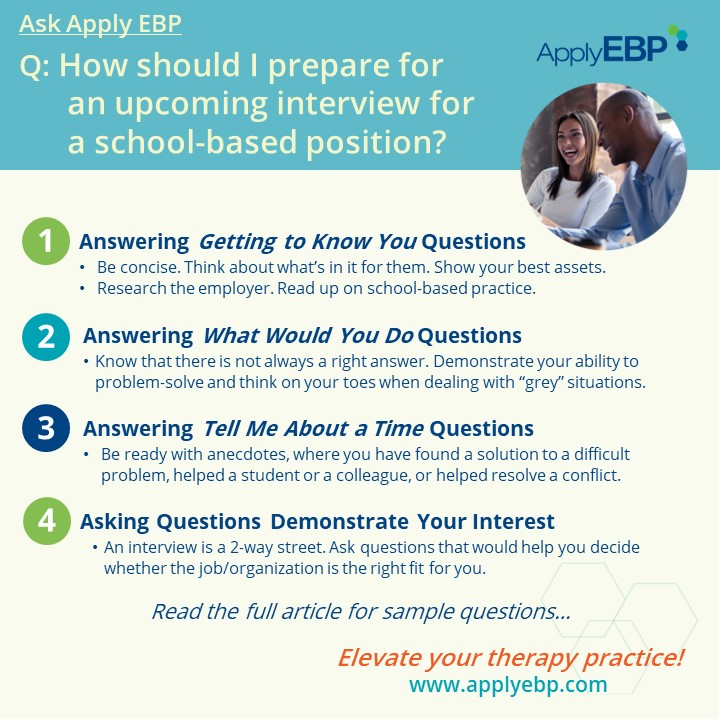
Answering Getting to Know You Questions:
-
-
- Be concise
- The first in the list above is likely the first question you will be asked. Before the interview, plan how you would share your education, experience, and expertise in under 2 minutes. If you do not prepare, it is easy to wander and bore your listeners. Come in with 3-5 points you want them to remember about you and your experience.
- Think what’s in it for them
- Getting to Know You questions are my least favorite type of questions. Often the answers are just a repeat of what is already contained in the application. But the questions still need to be asked. So how do you make your answers memorable? Answer questions always thinking about what’s most important for them.
- Research the organization. See what you can find on their website and social media. Find out their mission statement and values. Talk to a current employee and learn about the culture of the organization; they do not have to be a related service provider.
- By the way, as you do so, find out if they are the right fit for you.
- Read the job description. Remember the 3-5 points mentioned above? Make sure they align with the roles and responsibilities listed in the job description.
- Research the organization. See what you can find on their website and social media. Find out their mission statement and values. Talk to a current employee and learn about the culture of the organization; they do not have to be a related service provider.
- For example, when asked to describe your education and experience, share that part of your education and experience that would be of benefit to their students and their organization.
- Getting to Know You questions are my least favorite type of questions. Often the answers are just a repeat of what is already contained in the application. But the questions still need to be asked. So how do you make your answers memorable? Answer questions always thinking about what’s most important for them.
- Show your best assets:
- Read the article “8 Questions to Prepare You for School-based Practice.” Do any of the questions/answers resonate with you? Such as being a team player, having flexibility, working in a real-life environment, etc. If so, highlight those.
- Select to present your strengths as it relates to the organization’s mission, values, and the needs described in the job posting.
- As for that annoying “your weakness” question, there are lots of articles online on how to answer this question, so I’m not going to add more. My one suggestion is that don’t worry too much about this question. The interviewer knows as much, that it is a pointless question that happens to be in their list of what they need to ask. They know that interviewees will have canned answers. Just be ready to answer it as concisely as possible, then move on.
- Be concise
-
If you are lacking school-based experience, be ready to describe those parts of your education, internship, and clinical experience when you have worked with children and their families. Talk about why and how you want to expand on those experiences. Share with them how you plan to prepare for the position, such as what reading you plan to do, or what school-based courses you plan to take.
“What Would You Do” Questions in a School-Based OT, PT, or SLP Interview
This is one step up from Getting to Know You Questions in levels of difficulty and being interesting for interviewers. I call these the “what would you do…” questions. Here are some examples:
-
-
- A parent came to you with a prescription for your services from an outpatient clinic. What would you do?
- You have limited space and funds for materials. What would you do?
- A teacher asked you to assist with something that is not within your typical day-to-day roles and responsibilities. What would you do?
- You are recommending a decrease in services, but the team is asking for an increase in services. What would you do?
-
Answering What Would You Do Questions:
-
-
- Know that there is not always a right answer. What interviewers are looking for is your ability to problem-solve and “think on your toes.”.
- There are times when you have to show how decisive you can be, especially when the question is about safety. Or when the ethics or legal boundaries are clear. In this case, clearly share your reasoning citing IDEA, state guidelines, your licensing body, research, or others.
- But most cases are grey (i.e., not black or white). In this case, you need to show that you know how to empathize, be helpful, and be flexible. Talk out loud your problem-solving process. For example, that you know how to…
- Show understanding of a parent, administrator, or colleague by saying something like:
- “I see what you are saying…”
- “I understand your concern…”
- “That is a really good question…”
- Inform a parent, administrator, or colleague about what you will do by saying something like…
- “I will reach out to my supervisor (or whoever), and give you an update on…”
- “I want to give you accurate information, so let me confirm…”
- “I have heard about it, but let me look into it more, and I will get back to you in a week…”
- “I have not heard of that before, but let me research the answer for you…”
- Show understanding of a parent, administrator, or colleague by saying something like:
-
If you are lacking school-based experience, read our Ask Apply EBP articles to familiarize yourself with typical What Would You Do situations.
“Tell Me About a Time” Questions in a School-Based OT, PT, or SLP Interview
These are my favorite type of questions. Whether true or not, as an interviewer, I feel like I am getting to know the real interviewee more based on past actions. While What Would You Do questions are about what you would do, Tell Me About a Time questions are about what you have actually done. As such, they usually start with “tell me about a time when you…” Here are some examples:
-
-
- Tell me about a time when your recommendation is different from the team’s, and you had to get buy-in from them.
- Tell me about a time when a parent has approached you to provide services for their child that you know would not benefit from your services, or that has been shown to be ineffective..
- Tell me about a time when you had to advocate for a student’s needs in the school.
- Tell me about a time when you knew that you are right, but you had to compromise and resolve a conflict.
-
Preparing to Answer Situational Questions:
-
-
- Be ready with anecdotes to share. Think about times when you have found a solution to a difficult problem, helped a student or a team member, helped resolved a conflict, etc.
- Be as specific as possible on the situation you are sharing to make your stories more engaging and memorable.
- By the way, even if the interviewer does not ask Tell Me About a Time questions, your preparation is not for naught. Stories are more memorable. So you can share anecdotes when you are answering Getting to Know You or What Would You Do Questions. This will show the interviewers that your experience and capabilities are real.
-
If you are lacking school-based experience, think about situations at your current workplace, or during your internship or schooling where you had to deal with conflicts.
What School Districts Look for in School-Based OT, PT, and SLP Candidates
As an additional tip, it does not matter which of the 3 types of questions above you are asked, you should show the following characteristics that are essential for school-based therapists:
-
-
- Knowledge of school-based practice
- If you have no experience working in schools, here are some free resources to get you started:
- If you are looking for Professional Development:
- Team player
- Show that you can work with a team, from decision-making to providing interventions, especially when answering questions about, how do you determine need for services, or resolving conflicts
- Eagerness to make a difference in the lives of children
- This is the ultimate reason why we are working in the schools. If you really like working with kids, show your enthusiasm.
- Collaborator with Parents
- Demonstrate that you see parents as partners.
- Openness to learning
- As I mentioned, our schooling has not prepared us well for school-based practice. So show that you are open to learning.
- In my opinion, a lifelong learner is an attractive candidate as you know they are committed to always bettering themselves; while a know-it-all is not, as they will be inflexible.
- Problem-Solver
- This comes together with openness to learning. There are many grey areas in our practice. Show how you will deal with challenges.
- Knowledge of school-based practice
-
Do an honest self-reflection. Do you have the above characteristics? Or do you aspire to develop them? If yes, you would enjoy school-based practice.
Your Turn: Questions to Ask at the End of a School-Based OT, PT, or SLP Interview
At the end of the interview, you will be asked if you have any questions. Make sure to ask some questions so they know that you are interested in the job. This is also your opportunity to learn more about whether the job is the right fit for you.
Below is a long list of suggestions. However, make sure that you read the job posting first so you are not asking them to repeat what is already on there; instead ask questions that you do not yet know the answer to, and would like to know. Also, some organizations have a separate Human Resources interviewer/personnel that you can ask about the pay and perks of the job.
-
-
- Hours of work; are you expected to attend anything outside of the regular work hours?
- Summer work opportunity and pay (if the posting is for 10 months)
- Caseload (if they are using the workload model, even better; as them about the workload)
- Number of students
- Grade levels
- Health conditions
- Number of buildings
- Other responsibilities in addition to providing related services
- Time allotted for documentation, assessment, and other responsibilities
- Travel, if in multiple sites, and the payment/reimbursement for travel
- Pay scale: this can sometimes be complicated, so better to ask early; is there room for negotiation?
- Would you be part of the teacher contract/union?
- Benefits
- Time off (personal, sick, holidays)
- Pension/retirement
- What type of orientation you will receive for the job and the documentation needed (including billing, if you will be asked to bill Medicaid)
- Supervisor, mentor, and/or support for when you need it
- Professional development reimbursement
- Would they pay for membership with your professional organization?
- Types of services you are expected to provide:
- Whether embedded, separate, or a combination. While more embedded is best practice, it can differ from one organization to another.
- Individual or group?
- Space: now depending on the type(s) of services you are expected to provide, this can be a room or a space for interventions, storage, and/or documentation.
- Equipment or other tools: what does the school already have, and whether there will be a budget for you to purchase any
- Who you will be working with? If there is a team of therapists, how many?
- Why do they like their jobs/organization? Or their favorite aspects of their job/organization? Or what do they find fulfilling about their jobs/organization?
- What do they find most challenging about their jobs?
-
Final Tips for Your Specific Profession
For school-based OT interview preparation, be ready to talk about how occupational therapy can support participation in classroom routines, handwriting, sensory processing, self-regulation, assistive technology, activities of daily living, executive function, and collaboration with the educational team.
For school-based PT interview preparation, think about how physical therapy can support safe mobility, access to school environments, adaptive equipment, positioning, participation in routines, transportation, playground access, and collaboration with the educational team.
For school-based SLP interview preparation, prepare to discuss how speech-language pathology can support communication, language and literacy, AAC, social communication, executive function, participation in classroom routines, and collaboration with teachers and families.
Now, do your assignment and shine at your next job interview!
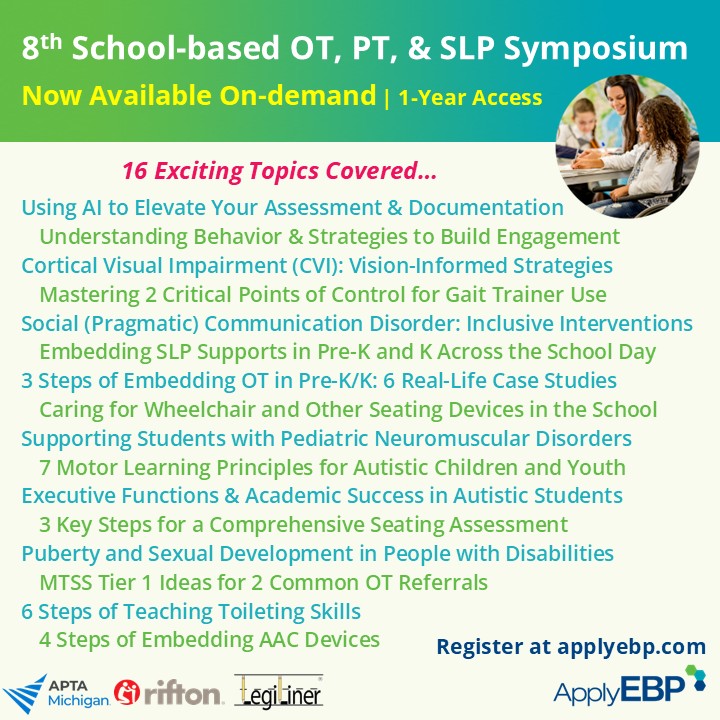
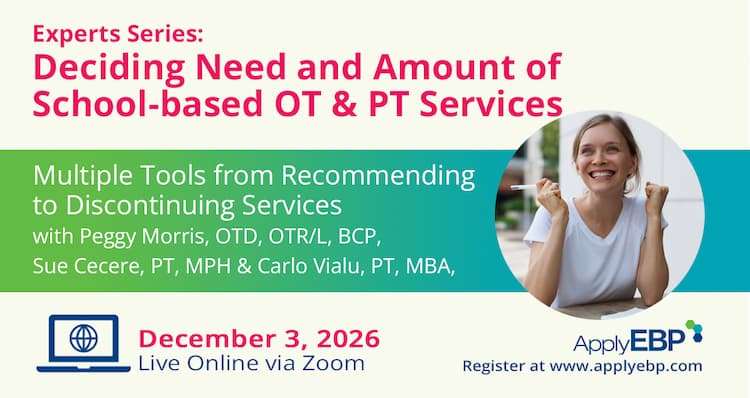
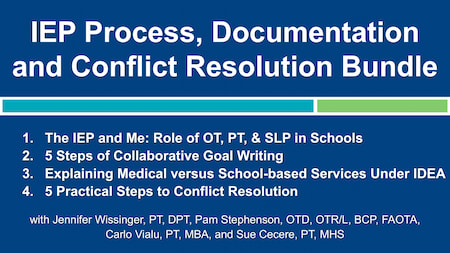
Want to feel more prepared before your school-based OT, PT, or SLP interview? The following Apply EBP courses can help you better understand school-based practice, IEP decision-making, documentation, collaboration, and educationally relevant services.