Q: What interventions work for children with DCD?
About one (1) in every 20 school-aged children has developmental coordination disorder (DCD). Chances are, you are already working with one—or will soon. Are you ready to make the biggest impact on your clients?
Below are three evidence-based approaches you can use—each with a short description, core components, and proven benefits:
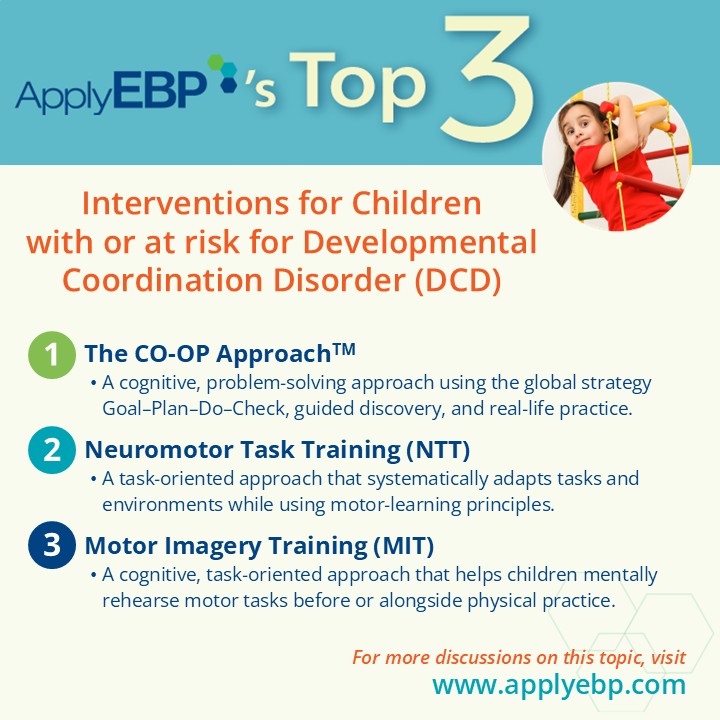
1. Cognitive Orientation to daily Occupational Performance (CO-OP)
A cognitive, problem-solving approach that helps the child discover how to perform their chosen goals using the global strategy Goal–Plan–Do–Check, guided discovery, and real-life practice.
Main Intervention Components
-
-
- Collaboratively set child-chosen goals (e.g., write a paragraph, ride a bike, tie shoes).
- Teach and coach Goal–Plan–Do–Check, prompting the child to generate and test strategies.
- Use guided discovery (ask-don’t-tell) to create a plan for task performance.
- Practice in meaningful environments; involve parents/teachers for carryover and homework.
-
Evidence-supported Benefits
-
-
- Improved performance on child-selected goals and participation outcomes in school/home contexts. Enhanced cognitive strategy use and signs of neuroplastic change reported in a recent systematic review.
-
Abbreviated Examples
-
-
- Writing: Child sets the goal (“write a neat paragraph”). Plan: “Say–Write–Check,” use letter-spacing guide; Do: practice short bursts; Check: compare to success criteria and revise plan.
- Self-care: For fasteners, child comes up with verbal prompt “stabilize with left, push with right”; checks success and tweaks plan.
- Stairs: To adopt step-through pattern, child tests “one foot each step” and “walk on the side”, evaluates outcome, and adjusts plan.
-
Start your CO-OP journey with our free article “Applying CO-OP Principles in School-based Practice” written by Lara Collins Barros, OTD, OTR/L.
2. Neuromotor Task Training (NTT)
A task-oriented approach that systematically adapts tasks and environments while using motor-learning principles (knowledge of results, variable practice, external focus) to drive skill acquisition and transfer.
Main Intervention Components
-
-
- Task analysis to pinpoint the “rate-limiting” motor control elements.
- Systematic progression of task constraints (speed, accuracy, surface, object size).
- Alternating blocked/variable practice with explicit and implicit cues.
- Ongoing performance feedback; self-evaluation to support generalization.
-
Evidence-supported Benefits
-
-
- Gains in task performance and standardized motor outcomes when delivered at adequate intensity, with improvements generalizing to similar functional tasks.
-
Abbreviated Examples
-
-
- Putting pants on: Start with loose fit elastic-waist pants, breaking the task into steps (sit on chair, hold waistband, step in with one leg, pull up, then the other leg, stand up to pull up all the way to the waist). Progress by performing task in standing, then transition to more complex clothing (e.g., jeans with fasteners).
- Basketball Shot: Start with a lowered hoop and larger, lighter ball. Provide external focus cues (e.g., “aim for the square”). Progress by increasing hoop height, using regulation ball, and adding defenders or time constraints.
- Cycling in the Community: Bicycle skills training in quiet lot → shared path → neighborhood route.
-
3. Motor Imagery Training (MIT)
A cognitive, task-oriented approach that helps children mentally simulate and rehearse motor tasks before or alongside physical practice. Motor imagery supports the development of internal models and enhances motor planning, timing, and execution.
Main Intervention Components
-
-
- Identify meaningful, functional goals (e.g., handwriting, tying shoes, throwing a ball).
- Guide the child through imagining the performance of each step vividly (visual and kinesthetic imagery).
- Combine imagery with action (e.g., imagine → perform) to reinforce motor learning.
- Use structured progression, beginning with simple tasks and advancing in complexity.
- Incorporate verbal cues, self-talk, and attention to sensory consequences.
-
Evidence-supported Benefits
-
-
- Research shows MIT can improve motor planning, movement efficiency, and functional outcomes in children with DCD. When combined with physical practice, MIT enhances skill acquisition and transfer to real-world activities.
-
Abbreviated Examples
-
-
- Classroom: Child imagines cutting along a line, focusing on how scissors feel in one hand and the paper feel in the other, then practices cutting paper with scissors.
- Playground: Before catching, child visualizes tracking the ball’s path and extending arms to meet and absorb the weight of the ball; then practices with progressively smaller/faster balls.
- Home: Child rehearses mentally each step of shoe-tying, including how tightly to hold and pull the laces while following a visual cue card, then physically ties shoes with visual cue card.
-
What All 3 Interventions Have in Common
CO-OP, NTT, and MIT are considered top-down interventions (also known as activity-oriented, participation-oriented, or task-oriented approaches), as they focus on practicing the real-life skills that children need and want to learn. In children withe DCD, top-down approaches have been shown to improve performance more efficiently — and in less time — than “bottom-up” or “body-oriented” approaches (e.g., sensory integration, perceptual-motor training).
Ready to Elevate Your Practice for Your DCD Clients
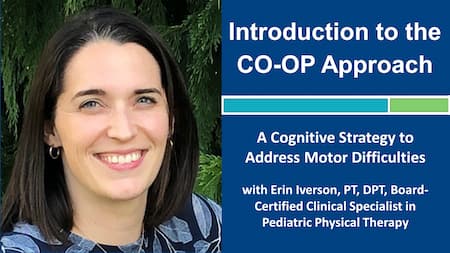
✨ Join Patti Sharp, OTD, OTR/L, BCP, for a dynamic session packed with practical, ready-to-use strategies for assessment, interventions, and differential diagnosis in children with or at risk for DCD. You’ll also get an Introduction to the CO-OP Approach to help you appreciate cognitive strategies that can transform how your clients master motor skills. Don’t just treat DCD—empower kids to thrive with this exciting course!
Coming Soon!
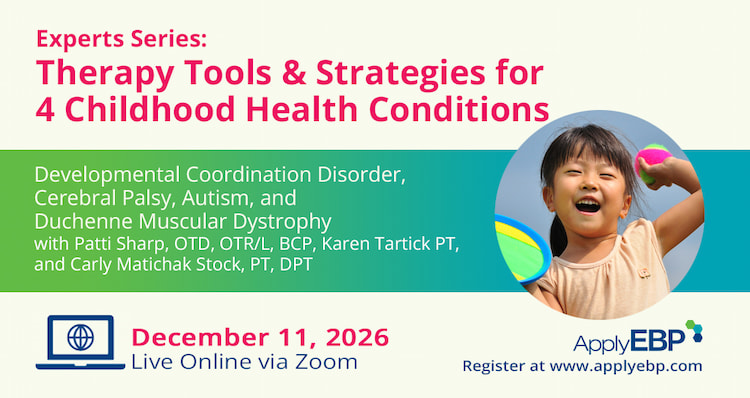
If you are interested in more evidence-based tools, strategies, and discussions about school practice, join…
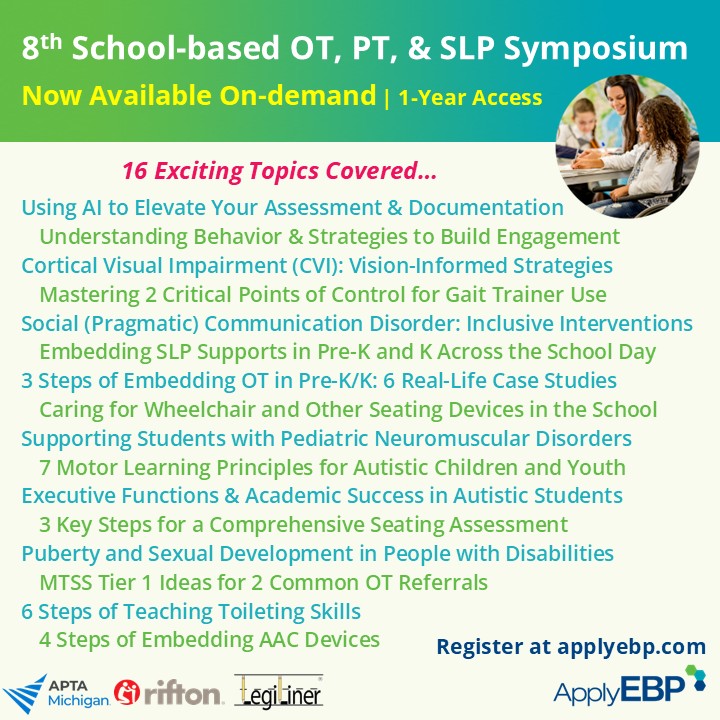
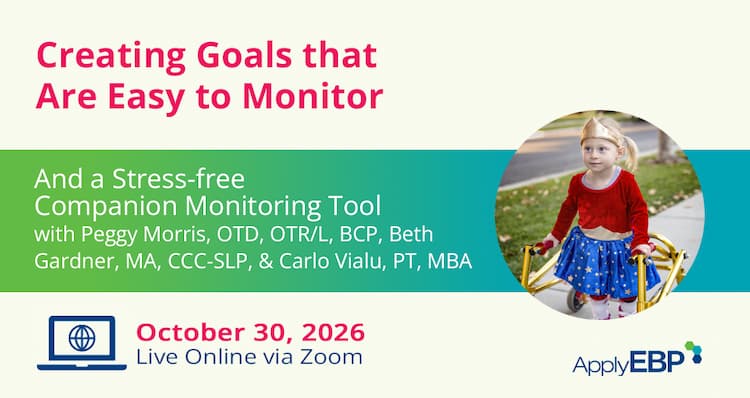

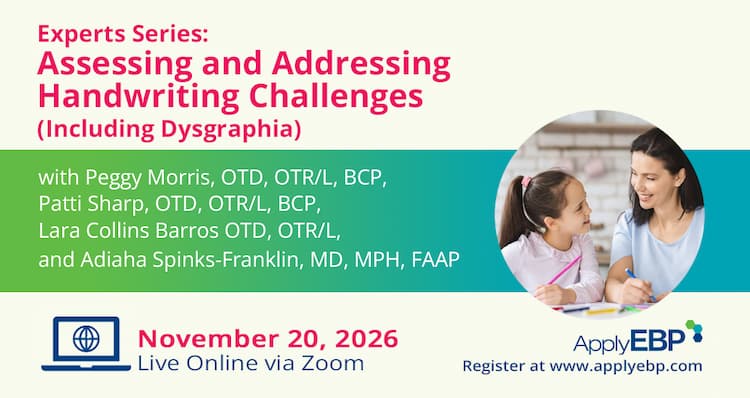
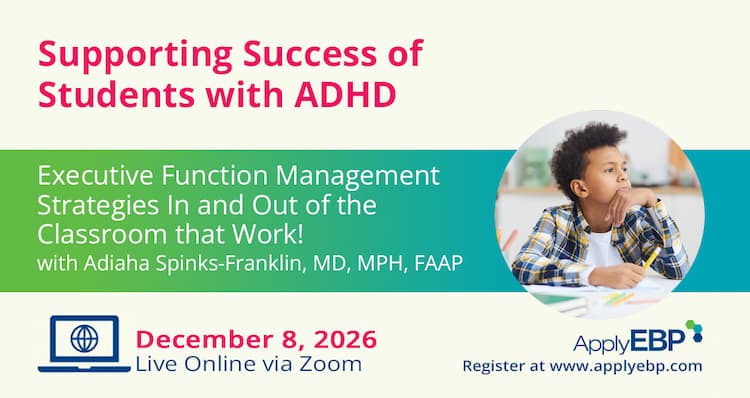
Or these webinars…

References
Baylis, M. (2020). 24-Hour postural care and use of sleep systems in cerebral palsy. Paediatrics and Child Health, 30, 296-302. https://doi.org/10.1016/j.paed.2020.05.005
Hulme, J., Gallacher, K., Walsh, J., Niesen, S., & Waldron, D. (1987). Behavioral and postural changes observed with use of adaptive seating by clients with multiple handicaps.. Physical therapy, 67 7, 1060-7. https://doi.org/10.1093/PTJ/67.7.1060
Hulme, J., Shaver, J., Acher, S., Mullette, L., & Eggert, C. (1987). Effects of adaptive seating devices on the eating and drinking of children with multiple handicaps.. The American journal of occupational therapy : official publication of the American Occupational Therapy Association, 41 2, 81-9. https://doi.org/10.5014/AJOT.41.2.81
Inthachom, R., Prasertsukdee, S., Ryan, S., Kaewkungwal, J., & Limpaninlachat, S. (2020). Evaluation of the multidimensional effects of adaptive seating interventions for young children with non-ambulatory cerebral palsy. Disability and Rehabilitation: Assistive Technology, 16, 780 – 788. https://doi.org/10.1080/17483107.2020.1731613
Lyman, J. (2021). Parent perspective on powered wheelchair standing devices. Developmental Medicine & Child Neurology, 63. https://doi.org/10.1111/dmcn.14862
Maximo, T., Foureaux, E., Wang, X., & Fong, K. (2020). Ciranda—An Inclusive Floor Seating Positioning System and Social Enterprise. International Journal of Environmental Research and Public Health, 17. https://doi.org/10.3390/ijerph17217942
McLean, L. J., Paleg, G. S., & Livingstone, R. W. (2023). Supported‐standing interventions for children and young adults with non‐ambulant cerebral palsy: A scoping review. Developmental Medicine & Child Neurology, 65(6), 754-772.
Paleg, G., Williams, S., & Livingstone, R. (2024). Supported Standing and Supported Stepping Devices for Children with Non-Ambulant Cerebral Palsy: An Interdependence and F-Words Focus. International Journal of Environmental Research and Public Health, 21. https://doi.org/10.3390/ijerph21060669
Ryan, S., Campbell, K., Rigby, P., Fishbein-Germon, B., Hubley, D., & Chan, B. (2009). The impact of adaptive seating devices on the lives of young children with cerebral palsy and their families.. Archives of physical medicine and rehabilitation, 90 1, 27-33. https://doi.org/10.1016/j.apmr.2008.07.011
Saavedra, S., & Goodworth, A. (2020). Postural Control in Children and Youth with Cerebral Palsy. Cerebral Palsy. https://doi.org/10.1007/978-3-319-50592-3_161-1
Verschuren, O., Peterson, M. D., Leferink, S., & Darrah, J. (2014). Muscle activation and energy-requirements for varying postures in children and adolescents with cerebral palsy. The Journal of pediatrics, 165(5), 1011-1016.