Q: My student’s AAC progress is slower than I expected and I’m not sure what to do next. Thoughts?
You completed the assessment and selected a device that appeared to be a strong fit. Yet months later, the anticipated communication “burst” hasn’t happened. Progress feels inconsistent—two steps forward, one step back!
So what might be missing?
While assessment and advocating for a device can be complex, implementation is often the most challenging phase of the AAC journey. Like any skill, AAC use improves with repeated, meaningful practice. The more opportunities a student has to use AAC, the faster progress tends to follow.
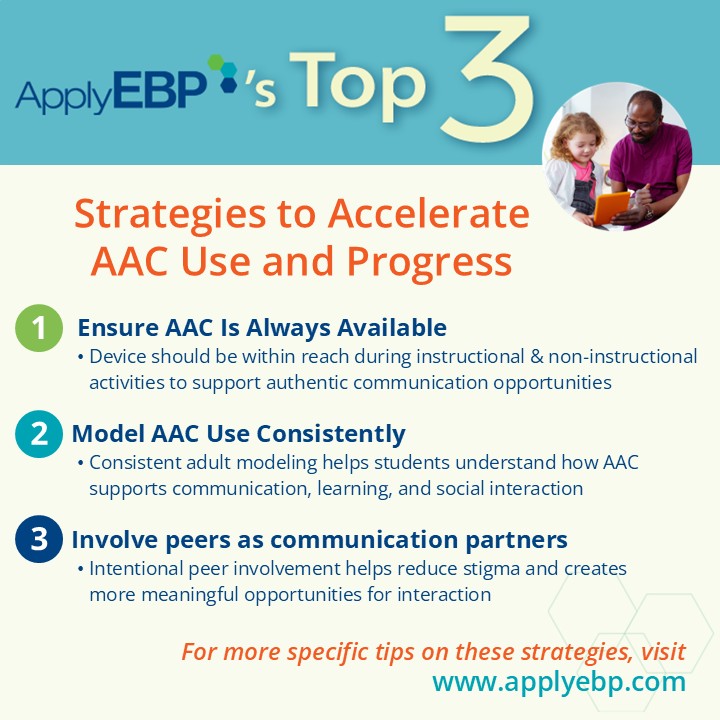
No child can get that level of practice from working with an SLP alone. However, there are concrete steps SLPs can take—and advocate for—to accelerate progress. Below are three evidence-informed strategies you can start using right away.
Here Are 3 Key Strategies for Accelerating AAC Progress
1. Ensure AAC Is Always Accessible
AAC must be present during both instructional and non-instructional activities to support authentic communication opportunities across the school routine.
-
-
-
- Devices should be in sight and within reach across settings, including the classroom, lunchroom, playground, restroom, and more.
- Teach the student to travel with their AAC. For a student with a mobility device, problem-solve with your OT and PT colleagues how to keep the AAC attached and accessible while moving throughout the school.
- Do not remove AAC as a disciplinary measure! Students deserve continued access to communication so they can express thoughts, share feelings, and advocate for themselves—even during challenging moments.
-
-
2. Model AAC Use Consistently
AAC use doesn’t happen on its own—it requires explicit instruction and modeling. Consistent adult modeling helps students understand how AAC supports communication, learning, and social interaction.
Examples of natural modeling include:
-
-
-
- During PE, the teacher can press the “pass to me” button on Matty’s device during a ball play activity.
- During an ELA discussion of Charlotte’s Web, the teacher finds and sequences the phrase “Wilbur lives on a farm” on Johnny’s device, then repeats the phrase verbally to support language mapping.
- In the lunchroom, the lunch aide uses AAC to offer and model mealtime choices.
-
-
To support consistent adult modeling:
-
-
-
- Provide coaching and in-services so team members feel confident using AAC.
- Collaborate to ensure the system includes words and phrases relevant to upcoming lessons and daily routines.
- Empower team members to add or update vocabulary as needed to support participation.
-
-
3. Involve Peers as Communication Partners
Research shows that students who use AAC are at increased risk for social isolation, in part because they may rarely see others communicate in similar ways (Berenguer et al, 2022; Severini et al, 2018). Intentional peer involvement helps reduce stigma and creates more meaningful opportunities for interaction.
-
-
-
- Allow peers to be curious about AAC while empowering the AAC user to decide who can use their device and when.
- Create opportunities for AAC use across school environments and routines for all students, such as:
- An AAC button at the door that any student can use to ask for the bathroom
- An AAC device available for all students to select tools during art class
- Encourage the AAC user to direct questions and comments to peers. Use Stay-Play-Talk to encourage more balanced responses and initiations (Thiemann-Bourque et al 2018).
-
-
Need More AAC Strategies?
If you’d like to learn more about implementing the above strategies, including the Stay–Play–Talk approach, along with other practical approaches to accelerate AAC progress, we invite you to join our courses designed specifically for SLPs and educators supporting AAC users.


References:
Berenguer, C., Martínez, E. R., De Stasio, S., & Baixauli, I. (2022). Parents’ perceptions and experiences with their children’s use of augmentative/alternative communication: A systematic review and qualitative meta-synthesis. International journal of environmental research and public health, 19(13), 8091.
Donaldson, A. L., Corbin, E., & McCoy, J. (2021). “Everyone deserves AAC”: Preliminary study of the experiences of speaking autistic adults who use augmentative and alternative communication. Perspectives of the ASHA Special Interest Groups, 6(2), 315-326.
Hanline, M. F., Dennis, L. R., & Warren, A. W. (2018). The outcomes of professional development on AAC use in preschool classrooms: A qualitative investigation. Infants & Young Children, 31(3), 231-245.
Moorcroft, A., Scarinci, N., & Meyer, C. (2018). A systematic review of the barriers and facilitators to the provision and use of low-tech and unaided AAC systems for people with complex communication needs and their families. Disability and Rehabilitation: Assistive Technology.
Thiemann-Bourque, K., Feldmiller, S., Hoffman, L., & Johner, S. (2018). Incorporating a peer-mediated approach into speech-generating device intervention: Effects on communication of preschoolers with autism spectrum disorder. Journal of speech, language, and hearing research, 61(8), 2045-2061.
Article created with AI editing assistance