
Q: Why should I write collaborative goals?
Writing goals together as a team— teachers, occupational therapy (OT), physical therapy (PT), speech & language pathology (SLP) and other related service providers (RSPs)—might feel time-consuming, but it pays off big time for students, teachers, and providers alike.
3 Benefits of Collaborative Goal Writing
Here are three key reasons why collaborative goals matter:
1. Focus on Participation:
Collaborative Goals Address Real-Life Student’s Needs
In our earlier article, “4 WH Questions/Elements of Participation-based Goals”, we emphasized why goals should be participation-based. Simply put, participation-based goals are best practice –
-
-
-
- They are motivating for children,
- Related service providers are most effective in addressing them, and
- They adhere to the intent of the IDEA (Individuals with Disabilities Education Act)
-
-
When RSPs collaborate with teachers, the resulting goals tend to reflect the student’s actual day-to-day experiences at school. Teachers contribute essential context—identifying when, where, and how students face challenges across academic tasks, functional routines, and social interactions.
As a result, goals go beyond isolated therapy tasks to focus on functional skills the student actually needs to participate in school—whether it is completion of classroom work during English Language Arts, motor planning for playground participation, or pragmatic language for group work.
2. Shared Responsibility:
Collaborative Goals Foster Team Investment and Carryover
Co-creating goals promotes a sense of shared ownership among team members. The goals no longer sit solely with the OT, PT, or SLP—they become team goals. This shift in mindset brings additional benefits:
-
-
-
- Teachers feel more connected to the goals and are more likely to consistently carryover strategies and accommodations.
- Related Service Providers feel more supported and valued as part of a broader educational team as they are no longer working on goals in isolation.
- Students benefit from cohesive, consistent support across all settings—something no individual provider can offer alone.
-
-
A unified team can more effectively rally around the student, reinforcing strategies and supporting growth throughout the school day.
3. Accelerated Progress:
Collaborative Goals Accelerate Meaningful Improvement
Skill development hinges on frequent, consistent practice. Consider these research highlights:
-
-
-
- Toddlers who are learning how to walk, walk 46 football fields per day. (Adolph et al, 2012)
- Children with Developmental Coordination Disorder (DCD) need 2–5 practice sessions per week for ~9 weeks to develop a skill (Dannemiller et al, 2020).
- Children with cerebral palsy require 25 hours of upper limb training to reach a therapy goal (Jackman et al, 2020).
-
-
This high amount of practice is often difficult to reach if we rely on time spent with RSPs alone. When every team member reinforces the same goals and strategies throughout the school day, students are provided with multiple opportunities to practice – a critical concept for skill development that we highlight in our article “Shifting Conversations from ‘Frequency of Services’ to ‘Opportunities for Practice’”.
Moreover, the collaborative process brings diverse expertise to the table. Teachers offer insight into classroom demands, while RSPs identify underlying factors—motor, communication, or self-regulation—that may impact performance. Together, the team can brainstorm, test, and refine strategies, leaving no stone unturned in supporting the student’s success.
Conclusion
Collaborative goal writing is a powerful practice! It ensures that
-
-
-
- Goals are grounded in real-life participation
- The team is invested and unified in providing the student consistent support
- Goals are achieved from the resulting multiple opportunities for practice
-
-
Taking time to co-create goals isn’t just a procedural task—it’s an investment in better outcomes for students, teachers, and practitioners alike.
Ready to Learn How to Create Collaborative Goals?
Download, read, and share the AOTA, APTA, and ASHA Joint Statement on Interprofessional Collaborative Goals in School-Based Practice. It covers the collaborative goal writing process, plus an example, and an FAQ.
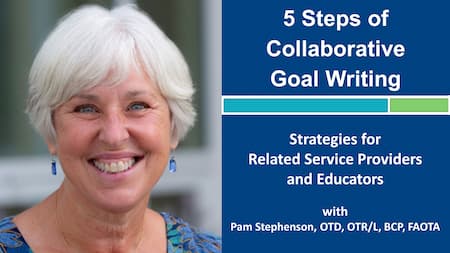
And when you are ready to up the ante, join Pam Stephenson’s “5 Steps of Collaborative Goal Writing: Strategies for Related Service Providers and Educators”
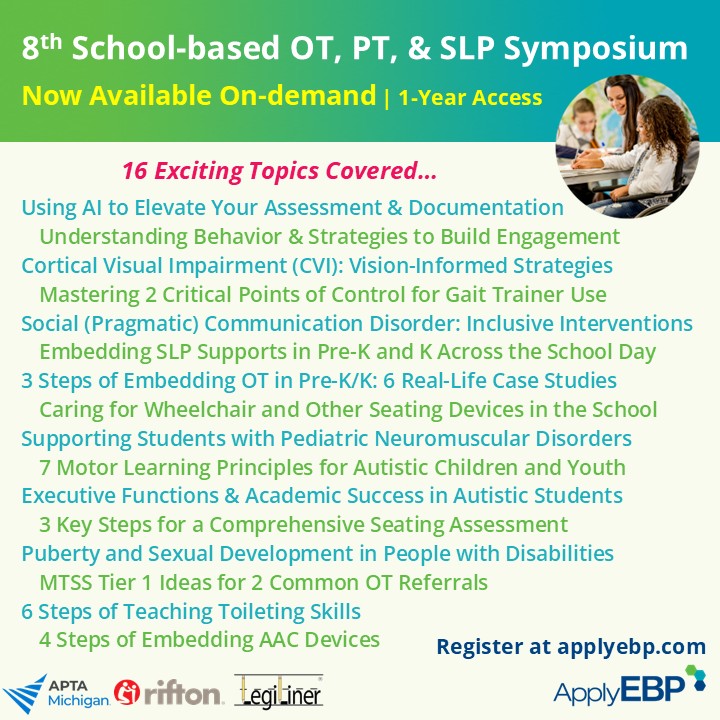
For more school-based discussions, join…


References
-
-
-
- Adolph, K. E., Cole, W. G., Komati, M., Garciaguirre, J. S., Badaly, D., Lingeman, J. M., … & Sotsky, R. B. (2012). How do you learn to walk? Thousands of steps and dozens of falls per day. Psychological science, 23(11), 1387-1394.
- Dannemiller, L., Mueller, M., Leitner, A., Iverson, E., & Kaplan, S. L. (2020). Physical therapy management of children with developmental coordination disorder: an evidence-based clinical practice guideline from the Academy of Pediatric Physical Therapy of the American Physical Therapy Association. Pediatric physical therapy, 32(4), 278-313.
- Jackman, M., Lannin, N., Galea, C., Sakzewski, L., Miller, L., & Novak, I. (2020). What is the threshold dose of upper limb training for children with cerebral palsy to improve function? A systematic review. Australian occupational therapy journal, 67(3), 269-280.
-
-