Q: How can I be more effective in supporting students with ADHD when their communication and behavioral needs overlap?
ADHD is often viewed through the lens of inattention and hyperactivity. However, research continues to reveal that ADHD is associated with a broader profile of communication and learning differences. These misconceptions can shape what school teams notice, which students are referred for evaluation, and which communication needs receive specialized attention.
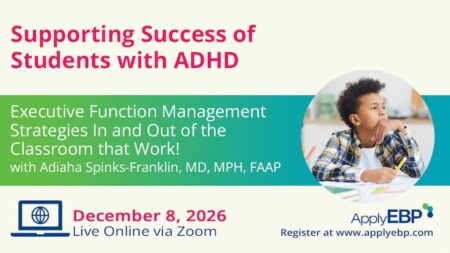
School teams may recognize the executive functioning challenges associated with ADHD while overlooking how these challenges interact with communication and learning. In her Boosting Impact of OT, PT, and Speech Services for Children with ADHD webinar, Dr. Spinks-Franklin discusses 12 domains of executive function that affect thinking, actions, and feelings. But how do these challenges show up in communication and learning, and what role can school-based SLPs play in identifying and supporting their needs?
Understanding the connections among ADHD, executive functioning, and communication can help SLPs identify needs earlier, provide more effective intervention, and strengthen collaboration with school teams. The three following evidence-informed considerations offer practical ways to expand how we recognize and support students with ADHD.
3 Critical Insights for SLPs
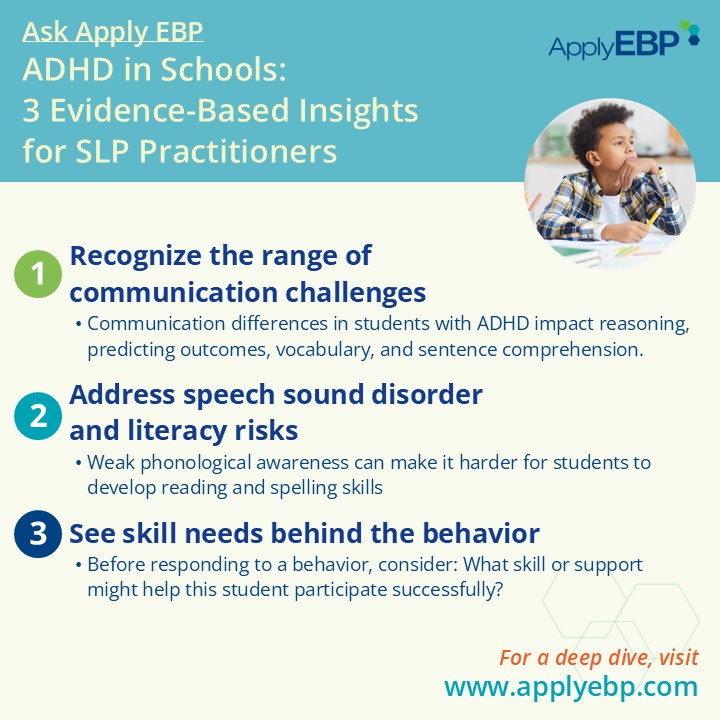
1) Recognize the range of communication challenges
Students with ADHD may experience challenges beyond social skills. Research suggests that many students demonstrate weaker expressive, receptive, and pragmatic language than their peers (Korrel, 2017), which can affect classroom participation, comprehension, academic performance, and peer relationships.
These differences may impact reasoning, predicting outcomes, vocabulary, and sentence comprehension. Although pragmatic language differences are commonly identified, they rarely occur in isolation (Matthews, 2018; Oshchepkova, 2025). Executive functioning, language processing, and self-regulation interact to influence how students understand language, express themselves, and navigate social situations (Filipe et al, 2020; Saul et al, 2023; Felix et al, 2024).
Consider these common experiences and their executive functioning skill:
-
-
- Planning and organizing: A student retells a story out of order, leaving out important details or jumping between events. Instead of reorganizing the story for the student, use a visual sequence or ask guiding questions such as, “What does your listener need to know first?”
- Impulse control and emotional regulation: A student struggles to disagree without arguing, interrupting or becoming frustrated. Use role-play to practice pausing, listening, and expressive disagreement without escalating the interaction. For example, “Wait, I have something to say,” “But I thought…,” or “I don’t agree!”
- Self-monitoring and conversational cues: A student continues talking without noticing that their listener is confused, distracted, or trying to take a turn. Explicitly teach students to pause, observe their listener’s response and non-verbal cues, and check-in by asking, “Does that make sense?” or “What do you think?”
-
Make social expectations explicit through modeling and structured practice. Collaborate with teachers and families so students can apply these strategies across settings.
2) Address speech sound disorder and literacy risks.
SLPs may overlook the impact of speech sound disorders in students with ADHD. While reduced intelligibility can be the most obvious concern, underlying phonological weakness can affect more than speech production. Weak phonological awareness can make it harder for students to develop reading and spelling skills. School-based SLPs are uniquely positioned to recognize these connections and help teams address communication and literacy needs together. (Lee, 2023; McGrath, 2008).
Practical strategies for school-based SLPs:
-
-
- Connect speech targets to classroom literacy. Incorporate speech sound practice and phonological awareness into shared reading and writing. For example, help students identify target sounds in words, connect them to their corresponding letters or spelling patterns, and practice using those words in meaningful reading and writing activities.
- Collaborate within MTSS. Partner with teachers to support classroom instruction, review screening and progress-monitoring data, and identify students who may need additional assessment or intervention. Use your knowledge of speech and language to select supports that address students’ underlying needs.
- Monitor literacy development. Continue to follow progress in phonological awareness, reading, and spelling, even after speech production improves. If a student produces a sound accurately but continues to struggle with sound-letter relationships or spelling, consider whether additional assessment or support is needed.
-
Not every student with ADHD will have a speech sound disorder or literacy difficulties. Recognizing these potential co-occurring needs can help SLPs identify concerns and connect students with appropriate support. Accurate speech is only one part of the picture: monitoring literacy alongside speech progress ensures that skills translate into meaningful participation and learning.
3) See skill needs behind the behavior
While behaviors are the most visible part of ADHD, they rarely tell the whole story. Difficulties with executive functioning, language processing, working memory, and self-regulation can contribute to behaviors that adults interpret as noncompliance, inattention, or impulsivity. As discussed in Dr. Spinks-Franklin’s ADHD course, understanding these underlying challenges can help school-based SLPs identify barriers to participation and advocate for more effective support.
Before responding to a behavior, consider: What skill or support might help this student participate successfully?
-
-
- Check understanding and task demands. Does the student understand the directions, remember the steps, and know how to begin? Simplify instructions, present directions in smaller chunks, or use a visual checklist.
- Support attention regulation. Reduce competing distractions, gain the student’s attention before giving directions, and pair spoken instructions with visual support. Help students recognize when their attention has shifted and practice strategies for refocusing.
- Make tasks manageable and predictable. Break complex activities into smaller steps, clarify what successful completion looks like, and build in opportunities to check progress, take breaks, and refocus.
-
When SLPs identify the skills affecting participation, they can help teachers and other team members choose supports that address students’ needs. Sharing observations and practical strategies across settings can promote greater independence and participation throughout the school day.
Ready to Continue your Evidence-based Practice (EBP) Journey?
Recognizing the connections among executive functioning, communication, speech, and literacy can help school-based SLPs identify overlooked needs and provide more effective support.
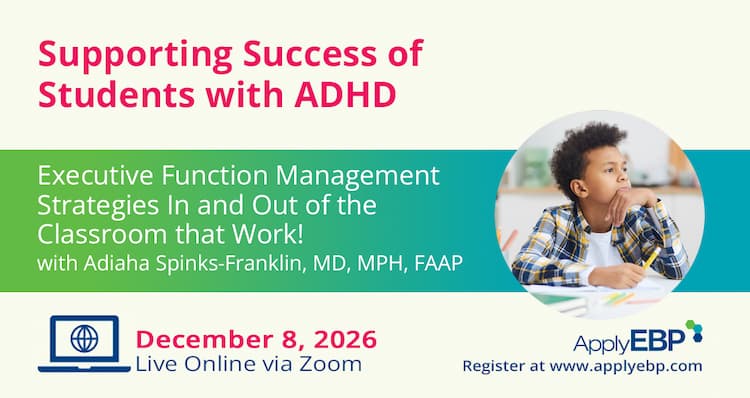
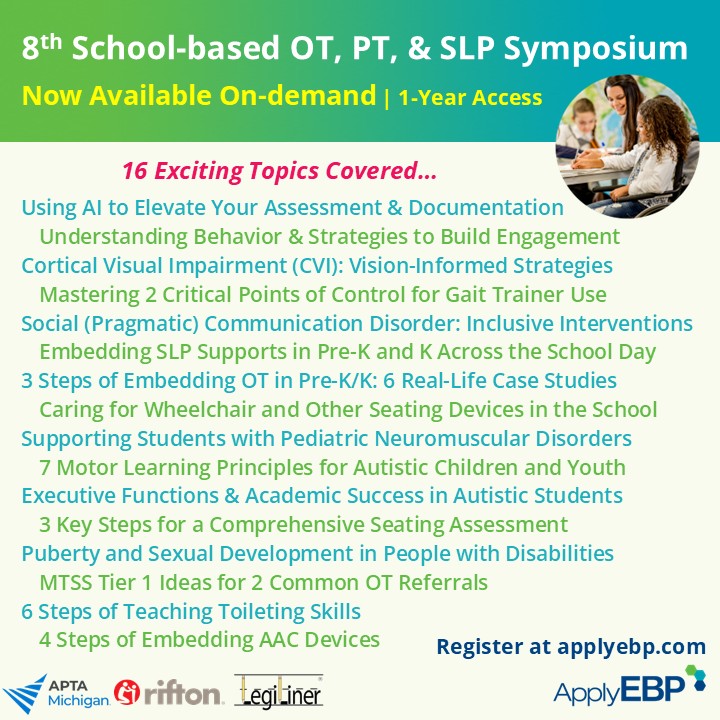
Ready to learn more? Join us for an upcoming course to explore the latest research on ADHD and gain practical, school-based strategies you can use to identify, support, and advocate for students.


References:
-
-
- Félix, J., Santos, M. E., & Benitez-Burraco, A. (2024). Specific language impairment, autism spectrum disorders and social (pragmatic) communication disorders: Is there overlap in language deficits? A review. Review Journal of Autism and Developmental Disorders, 11, 86–106. https://doi.org/10.1007/s40489-022-00327-5
- Filipe, M. G., Veloso, A., Frota, S., & Vicente, S. G. (2020). Executive functions and pragmatics in children with high-functioning autism. Reading and Writing, 33(4), 859–875. https://doi.org/10.1007/s11145-019-09975-2
- Katsarou, D. V., Efthymiou, E., Kougioumtzis, G., Sofologi, M., & Theodoratou, M. (2024). Identifying language development in children with ADHD: Differential challenges, interventions, and collaborative strategies. Children, 11(7), Article 841. https://doi.org/10.3390/children11070841
- Korrel, H., Mueller, K. L., Silk, T., Anderson, V., & Sciberras, E. (2017). Research review: Language problems in children with attention-deficit hyperactivity disorder—a systematic meta-analytic review. Journal of Child Psychology and Psychiatry, 58(6), 640–654. https://doi.org/10.1111/jcpp.12688
- Lee, E. J. (2023). Differences in language and literacy competence according to the comorbidity of speech sound disorder and attention-deficit/hyperactivity disorder: For preschool 6-year-olds. Communication Sciences & Disorders, 28(4), 761–775. https://doi.org/10.12963/csd.231007
- Lyakso, E., Frolova, O., Lebedev, A., Shabanov, P. D., Grechanyi, S., Atamanova, E., Kovelenova, M., & Limarenko, V. (2026). Behavior and speech features of children with ADHD. Healthcare, 14(6), Article 814. https://doi.org/10.3390/healthcare14060814
- Matthews, D. E., Biney, H., & Abbot-Smith, K. (2018). Individual differences in children’s pragmatic ability: A review of associations with formal language, social cognition, and executive functions. Language Learning and Development, 14(3), 186–223. https://doi.org/10.1080/15475441.2018.1455584
- McGrath, L., Hutaff-Lee, C., Scott, A., Boada, R., Shriberg, L., & Pennington, B. (2008). Children with comorbid speech sound disorder and specific language impairment are at increased risk for attention-deficit/hyperactivity disorder. Journal of Abnormal Child Psychology, 36(2), 151–163. https://doi.org/10.1007/s10802-007-9166-8
- Oshchepkova, E., Shatskaya, A., & Tarasova, K. (2025). The contribution of executive functions and emotion comprehension skills to the development of pragmatic competence in 5–8-year-old children. Frontiers in Psychology, 16, Article 1659576. https://doi.org/10.3389/fpsyg.2025.1659576
- Saul, J., Griffiths, S., & Norbury, C. F. (2023). Prevalence and functional impact of social (pragmatic) communication disorders. Journal of Child Psychology and Psychiatry, 64(3), 376–387. https://doi.org/10.1111/jcpp.13705
-