Q: What’s the best way of explaining my role as a school-based OT, PT, or SLP practitioner?
It’s been a few years since we published an article on SeekFreaks about preparing an Elevator Speech, but the questions about our roles as school-based OT, PT, and SLP practitioners haven’t gone away. So, we decided to revisit the topic and ask some of our newest Apply EBP instructors how they respond and explain when someone asks some variation of: “OT/As, PT/As, and SLP/As in schools? What do you do here?”
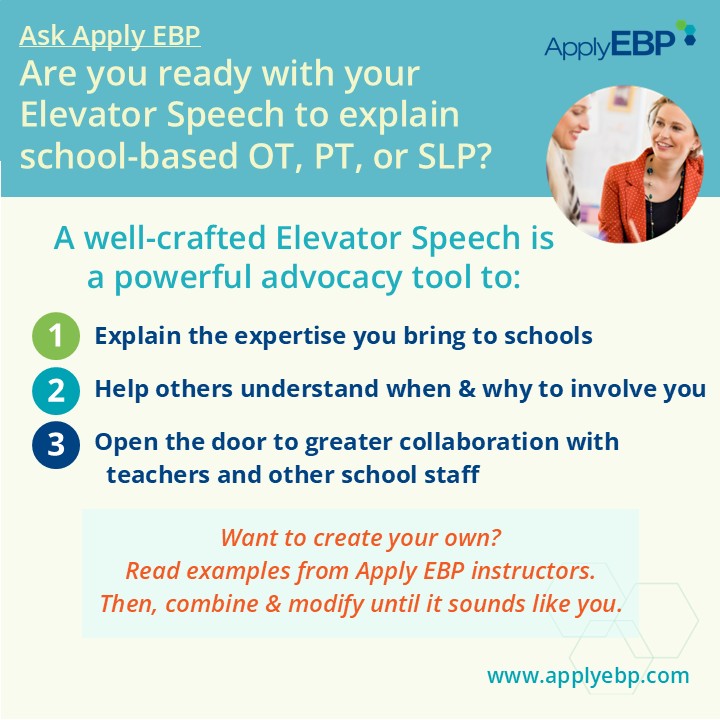
Why have an elevator speech? A well-crafted Elevator Speech can be a simple but powerful advocacy tool to:
-
-
- Explain the expertise you bring to schools
- Help others understand when and why to involve you
- Open the door to greater collaboration with teachers and other school staff
-
Thinking it’s too much work to come up with one? Don’t worry! In this article we are giving you a shortcut to coming up with your own Elevator Speech. You can adopt one of the scripts below, combine ideas from several, or modify them until they sound like you. Then practice it, so the next time someone asks what you do in the schools, you’re ready to answer. And don’t forget, there are more examples in our SeekFreaks article on Elevator Speeches.
School-based Occupational Therapy Elevator Speeches
“Occupational therapy in schools is about participation. I look at what students can do and what they need to do to fulfill their job of being a student. Then I close the gap between the two, often for one child, sometimes for a whole classroom of them.”
– Lou Ann Hintz, PhD, OTR, presenter of the webinar “MTSS Tier 1 Ideas for 2 Common OT Referrals: Supporting Handwriting and Sensory Needs”
“I love school-based practice! OT practitioners support students in accessing and participating in everyday occupations in natural contexts. The myth is that we only focus on academics and students with disabilities, and that can seen very limiting. We need to walk through all the occupations and activities that all students and teachers do during the course of a school day, and also the full school year. This helps us identify strengths as as well as needs. It includes social and functional participation at lunch and recess, special activities such as field trips, navigating the restroom and bus, as well as group-based and individual activities in the classroom. It also includes strategies for Tier 1 wellness and prevention strategies and supports for the whole school population, including teachers and other educational staff. We have under-recognized roles in supporting the development of literacy, self-regulation skills, and curriculum development. OT practitioners bring a lot of expertise to the table, including activity analysis, environmental scans, groupwork skills, and interpersonal problem-solving skills. We are, by nature, a collaborative profession and this is a great asset for school-based practice. Thinking from a drop-down, occupations perspective helps us not only to support student needs, but also to convey our distinct value as part of the educational team.”
– Pam Stephenson, OTD, OTR/L, BCP, FAOTA, presenter of the webinar “3 Components of a Thorough School-based OT Evaluation”
“I work with kids on making sure they can access all of their education and functional skills in all school environments, including academic classes, recess, bathroom, lunch, and social activities. Sometimes that means working on fine motor skills like scissor skills and writing, sometimes, cognitive act of writing like composing written work, sometimes ADLs in school like getting in and out of outerwear for recess and going home and eating like opening packages in class. I also help students access academics through assistive technology – which is technology for disability.”
– Michelle Kaye Silverman, OTD, OTR, ATP, co-presenter of the live course “Using AI to Elevate Your School-based Assessment and Interventions”
“As a school-based OT I get to work with students and teachers to support participation throughout the school day. I then tailor it to the grade level they are teaching. So, for a new K-2 teacher, I would add collaborating and problem-solving on using school tools, completing multi-step activities, and of course supporting handwriting acquisition and legible handwriting. For a teacher of students 3-5th grade, I add collaborating and problem-solving to support classroom routines, organization/planning, and supporting legible written expression and productivity. For older students I add on whatever is appropriate for that grade, lockers, gym clothes, using science materials…. I always stress that OTPs are available to support using the MTSS model and try to use teacher words over therapy words. I’d rather support a teacher who can support students every day now and in the future than wait for a referral!”
– Lara Collins Barros, OTD, OTR/L, co-presenter for the live course: “Experts Series: Assessing and Addressing Handwriting Challenges, including Dysgraphia”
School-based Physical Therapy Elevator Speeches
“School-based physical therapists collaborate with school teams regarding student access to their learning environments. We support a student’s positioning, mobility, and gross motor skills so they can get to where the learning happens and can functionally participate in that learning.”
– Rebecca AA Wilson, PT, MPT, MS, C/NDT, presenter of the webinar “Supporting Students with Pediatric Neuromuscular Disorder Across the School Day”
“As a school-based physical therapist, I utilize an integrated consultative and push-in service delivery model. I collaborate closely with the multidisciplinary team—including teachers, support staff, related service providers, and families—to establish student-centered goals for both home and school environments. Rather than isolating motor skills, we embed functional mobility into daily academic routines and transitions, from morning arrival to dismissal. Through hands-on positioning, staff modeling, and collaborative problem-solving within the classroom, this model equips the entire team to integrate movement naturally throughout the school day.”
– Cathy Ripmaster, MSPT, presenter of the webinar “Mastering 2 Critical Points of Control for Gait Trainer Use”
“My job is to help students develop the strength, balance, mobility, and positioning they need to safely participate in school, from walking in the hallways and navigating the playground to sitting comfortably in class and accessing learning. Every day is different. I get to play, be creative, solve problems, and work alongside amazing teachers, therapists, and families to help kids become as independent as possible. I even get to do aquatic therapy, and I’m known for being the person who can usually fix or adapt equipment when needed. Beyond my clinical work, I also enjoy giving back to the profession by developing online continuing education courses and professional writing. I really love that everyday challenges me to think, collaborate, and make a meaningful difference.”
– Joanne Bundonis, PT, PCS, ATP/SMS, C/NDT, presenter of the webinar “Caring for Wheelchair and Other Seating Devices in the Schools”
“As a school PT, I help students participate as fully as possible in their school day by supporting their mobility, positioning, and physical access. My specialty is 24-Hour Postural Care, so I also help teams think beyond the school day by looking at how positioning during sitting, standing, and even sleep can support comfort, function, participation, and body shape over time.”
– Pamela Cummings, M.Ed, PT, presenter of the live course “Positioning Strategies to Promote Participation and Prevent Asymmetry”
School-based Speech-Language Pathology Elevator Speeches
“A speech-language pathologist in the school setting does much more than work on speech. We help students develop the communication and language skills they need to access their curriculum, participate in class, and become more independent learners. We implement IEP goals in meaningful, curriculum-based ways, so the skills students are working on connect directly to what they’re learning in school. We also collaborate closely with teachers, special educators, counselors, and other related service providers to make sure everyone is working toward the same goals. Ultimately, we’re part of the student’s team, helping them communicate, advocate for themselves, and successfully navigate the academic and social demands of school.”
– Panagiota Tampakis, SLPD, CCC-SLP, presenter of the webinar “Executive Function and Academic Skills in Autistic Students”
“Hi, I’m Celeste, the speech-language pathologist on site! I’m here because of IDEA, the federal law that guarantees every child the right to an education in their least restrictive environment. That means I work with my students in the classroom, on the playground, or snack time for example. My primary job is to make communication functional so a child can ask for a turn, tell a friend they’re sad, or follow a simple direction. At this age, I focus on helping them gain communication skills that help them participate right now. I’m part of the IEP team, and I work alongside teachers to support access and inclusion for every student. Unlike clinic-based therapy, I don’t pull kids out for drills, but I do embed goals into their real day. I’ll be with your student through their journey at our school and across every environment they learn in. It is lovely to make your acquaintance and I’m so glad to be partnering with you!”
– Celeste Voss, MA CCC-SLP, presenter of the upcoming webinar “Targeting Consonant Cluster Reductions”
“As a school-based speech-language pathologist, my job is to help students communicate, learn, participate, connect, and advocate for themselves across the school day. I use my expertise in communication to identify and reduce barriers that may prevent a student from fully accessing instruction, participating with peers, or demonstrating what they know. I work collaboratively with students, families, teachers, and other team members to develop and adapt the environment, instruction, or supports around them. Ultimately, I want every student to have the communication tools, strategies, and confidence they need to be an active and successful member of their school community, and to carry those skills into college, careers, and life.”
– Dawn Merth-Johnson, MA,CCC-SLP, co-presenter of the live course “Using AI to Elevate Your School-based Assessment and Interventions”
“My speech services might look different than what you’ve seen in the clinic. I want speech and language to be meaningful and motivating. I look at how your student is using and understanding language throughout their day here at school. That includes the classroom with curriculum, but also during specials, and anytime they are interacting with other students. I will support your student in real-context settings as much as possible so we can practice using skills when they matter the most. I also work with the whole team to ensure we are all using strategies to promote communication skills and on the same page with IEP goals. Communication is happening all day in one way or another, so I’m here to make sure we are maximizing those opportunities and seeing progress.”
– Beth Gardner MA, CCC-SLP, co-presenter for the live courses, “Creating Goals that Are Easy to Monitor” and “Expert Series: IEP Process, Documentation, and Conflict Resolution.”

Want more tools for the start of the school year?
Check out these free articles and resources:
-
-
- Start-of-the-Year Family Introduction Letter, Download Your Free Template – in English, Spanish, and Chinese
- Uses of Ecological Assessments, Plus a Free Ecological Assessment Form – a great tool for observing the student to understand their needs this school year
- School-Based vs Medical-Based OT, PT, and SLP Services Under IDEA – an infographic you can share as another advocacy tool
- For more Elevator Speech Examples, read the SeekFreaks article: “School-based Therapists…Do You Have an Elevator Speech?”
-
Ready to continue your EBP journey?
Check out more upcoming opportunities for learning…