Q: The teacher reports delays (e.g., language &, communication, completing class work, walking the hallway), but the student tested average on norm-referenced tests. What am I missing?
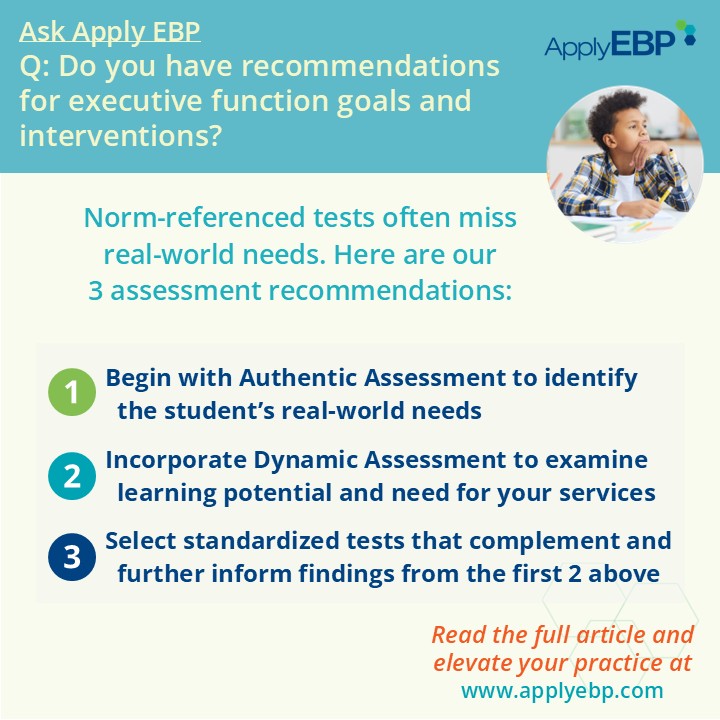
Short answer: Norm-referenced tests don’t tell the whole story. Additional assessment approaches are critical for understanding a student’s real-world challenges.
Long answer: Here’s Apply EBP’s expanded perspective and our 3 recommendations:
The Shortcomings of Norm-referenced Tests
If you’ve ever looked at a student’s language and communication test scores and thought, “That does not seem to tell the whole story” or “That’s not really helpful”, you’re not alone.
Norm-referenced assessments, such as
-
-
- Test of Pragmatic Language (TOPL), Clinical Evaluation of Language Fundamentals (CELF), and Preschool Language Scale (PLS) for Speech
- Bruininks-Oseretsky Test (BOT), Beery Visual Motor Integration (Beery VMI), Developmental Test of Visual Perception (DTVP), Movement Assessment Battery for Children (M-ABC), and Miller’s Function and Participation Scales (M-FUN) for OT and/or PT practice
-
are typically employed by school teams to compare a child’s performance to their peers to help determine whether a student’s delay is such that they should be eligible for special education services under IDEA.
While contributing important data points, many norm-referenced are static assessments, thereby presenting multiple limitations, such as:
-
-
-
- Items are decontextualized items: Skills are measured in isolation, making it difficult to connect the child’s test performance to their real-world performance. As such, a child may score well in a controlled testing environment, but not when they have to perform the task next to their peers in a busy classroom, hallway, or lunchroom.
- Snapshot in time: Results capture performance at a single point in time without reflecting the child’s learning potential. Many static tests follow strict procedures that limit the examiner’s ability to gain additional insight beyond whether the child can complete the task on command or not.
- Peer comparisons can be misleading: Students with lifelong disabilities are often chasing scores as the performance gap against their peers widens with age. As a result, their progress may not be fully captured.
- Do you want to dive deeper to understand why? Read “Why Norm-referenced Tests Are Poor Outcome Measures…and Better Options”
- Items are decontextualized items: Skills are measured in isolation, making it difficult to connect the child’s test performance to their real-world performance. As such, a child may score well in a controlled testing environment, but not when they have to perform the task next to their peers in a busy classroom, hallway, or lunchroom.
-
-
For these reasons, conducting static assessments provides only one piece of the puzzle. We need more to determine the true needs of the child.
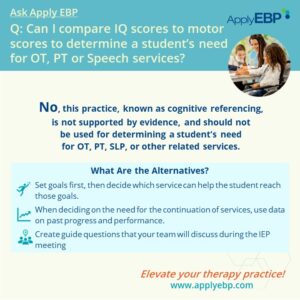
As an important reminder, IDEA states that “In conducting the evaluation, the local educational agency shall…not use any single measure or assessment as the sole criterion for determining whether a child is a child with a disability or determining an appropriate educational program for the child” (IDEA Section 1414 (b) (2) (B))
Which leads us to the question, what assessment approaches can help determine the real-world needs of the child?
Here are our 3 of our recommendations!
1. Authentic Assessment
Authentic assessment is an ongoing process that evaluates what a child can do within meaningful, real-world contexts. Rather than relying solely on decontextualized tasks, it examines how a child communicates and participates during everyday routines.
Here’s the quick 3 steps of performing Authentic Assessments:
-
-
-
- Interview the teacher, family members, and other team members to understand the child’s participation in daily routines and when challenges typically occur.
- Observe emerging skills, needs for support, and participation patterns during those identified daily routines. You can incorporate such data collection methods as language sampling and audio recording (for speech), work samples (for occupational therapy), or video recording (for OT, PT, and speech).
- Analyze the child’s participation in relation to the teacher’s expectations and peer performance (e.g., whether it aligns, varies slightly, or differs significantly).
-
-
For example:
-
-
-
- For a child with a fluency disorder, observing participation in class discussions or lunch conversations with peers can provide more meaningful information than conducting static task repetitions.
- For a child with self-regulation concerns, observing participation during times self-regulation is reported to be most challenging for the child, such as morning routine, returning after recess, or during lunch, will provide context to triggers for dysregulation.
- For a child with motor concerns, observing during physical education or recess can provide information on the child’s performance in structured and unstructured physical activities with their peers.
-
-
Additionally, Apply EBP recommends prioritizing Authentic Assessments first. Beginning with real-world performance provides a functional foundation for decision-making and helps you narrow down which norm-referenced measures are most relevant for further understanding the child’s needs.
By the way, Authentic Assessment, a term that is commonly used in Speech practice, may be called differently: Participation-based assessment for PT/As, while OTPs use the term Occupation-based assessment. If you want to learn more about these, read Apply EBP’s Must Have Test and Organizing Your School-based Assessment.
Authentic Assessments do not have to end after you write your initial report! Regular observation in real-life contexts allows your team to monitor progress, identify ongoing or new barriers, and adjust strategies efficiently. It can also inform goal development and day-to-day intervention planning.
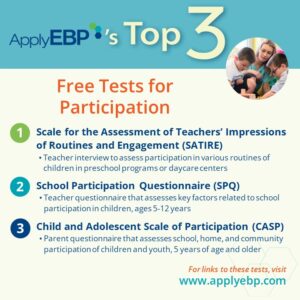
Not sure how to start with performing Authentic Assessments? Here’s a couple of useful tools:
Takeaway: Start with Authentic Assessment to understand the child’s real-world needs.
2. Dynamic Assessment (DA)
Dynamic assessment blends assessment and intervention, giving us a window into how a child learns. Instead of focusing solely on current skill level, it emphasizes learning potential by observing how a child responds to direct teaching.
Dynamic assessment utilizes the test-teach-retest method:
-
-
-
- Test a skill of concern
- Teach the skill
- Retest to gauge improvements
-
-
The results provide critical information for decision-making, such as:
-
-
-
- Differentiating whether difficulty reflects limited prior exposure to a task rather than a true underlying skill deficit
- Determining the child’s readiness to learn the targeted skill at this time
- Through repeated DA—using varied intervention methods during the “teach” phase—you can identify the child’s reactiveness or responsiveness to your interventions and which strategies are most likely to support progress
- Clarifying whether OT, PT, or SLP intervention is needed to support continued progress or if classroom-based strategies alone would be sufficient
-
-
Here’s a quick example of a Dynamic Assessment: A child is referred for reading concerns. The SLP begins with a list of 10 nonsense words, noting error patterns. After modeling a blending strategy and providing guided practice, the child receives a new list of 10 nonsense words. The SLP then tracks how quickly the child learns the strategy, how much improvement occurs, and how much support is needed to maintain success. OTPs can do a similar approach to examining a child’s ability to use classroom tools (e.g., scissors), and PTs can use the same for examining stair negotiation skills.
When performing DA, it is important to be intentional in:
-
-
-
- Defining a “good response” to intervention
- Choosing teaching strategies that another therapy practitioner could use to gather similar information—not just what works best in our own hands (Fuchs, 2003; Lam, 2024; Wood, 2024).
- Using graduated prompts to see how much support the child needs and tracking how efficiently they respond to increasing scaffolds.
-
-
To learn more about Dynamic Assessments, take Using AI to Elevate Your School-based Assessment and Documentation.
Takeaway: Dynamic Assessments can help identify true skill deficit and potential to progress with OT, PT, and/or SLP services.
3. Standardized Tests that Reflect Real Life Skills
Standardized tests can still be useful in assessments. But we need to be critical of which ones we choose to administer. Aligning with the ideas of authentic and dynamic assessments, consider tests that capture functional abilities in real-world contexts. Look for criterion-referenced assessments, and not just norm-referenced assessments.
Key qualities to look for in a functional test include:
-
-
-
- Participation-focused items: Test items should reflect meaningful, everyday interactions
- Flexibility in test administration: Tests that allow demonstration, repeated attempts, other means of providing directions (verbal, visual, etc.), and gathering data via different methods (observation, interview, etc..)
- Alignment with Real-life Needs Identified via the Authentic Assessment as already described in #1 above
-
-
Some examples are:
-
-
-
- Developmental Assessment of Young Children (DAYC-2)
- Focus on the Outcomes of Communication Under Six (FOCUS)
- Communication Function Classification System (CFCS)
- Glaspey Dynamic Assessment of Phonology (GDAP)
- School Function Assessment (SFA)
-
-
Takeaway: Thoughtful selection of standardized tests is key!
Ready to Continue your Evidence-based Practice (EBP) Journey?
For more meaningful evaluations:
-
-
-
- Begin with Authentic Assessments to define real-world needs
- Incorporate Dynamic Assessment to examine learning potential and need for OT, PT, or SLP support
- Select Standardized Tests that complement and further inform findings from Authentic Assessment
-
-
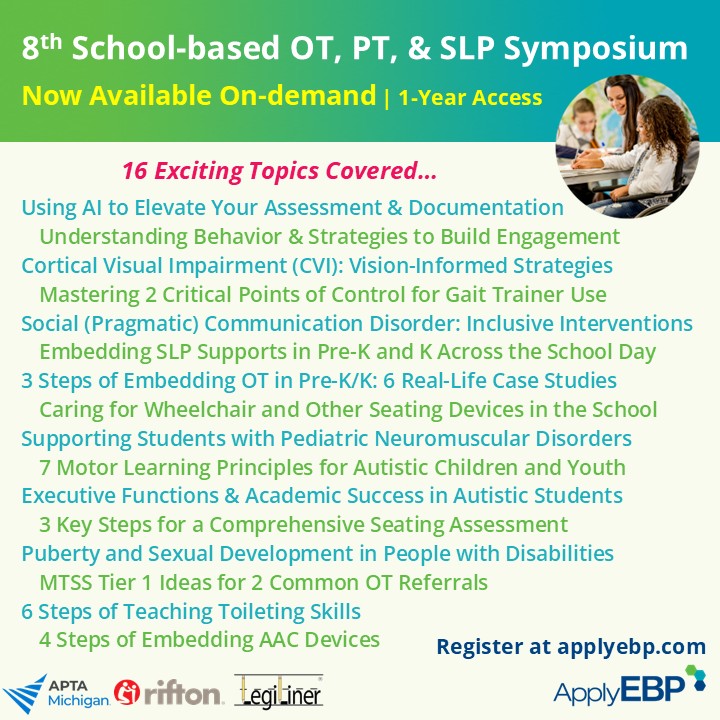
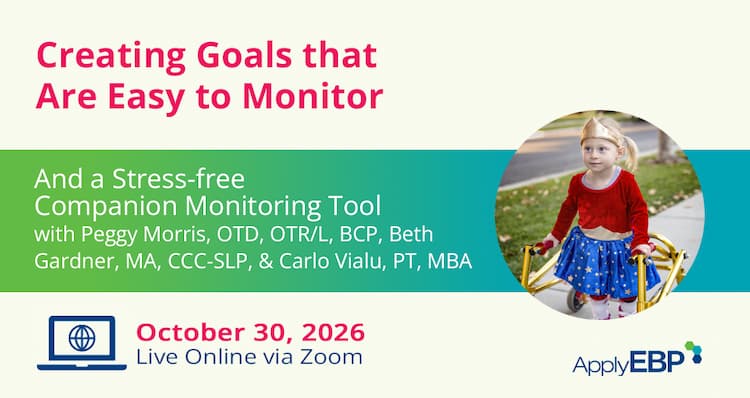
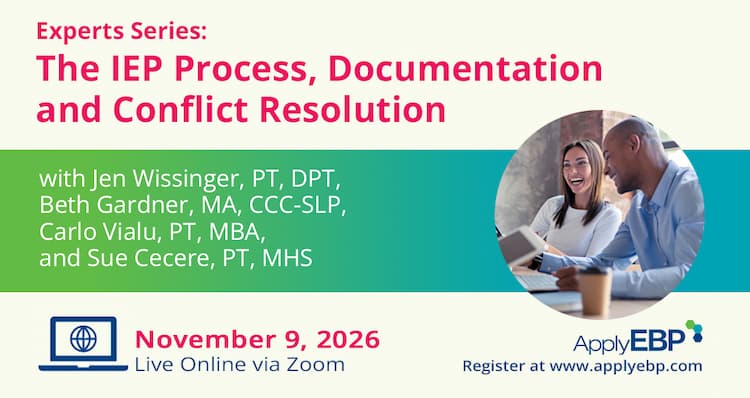
If you want to learn more about best practices for the school setting, join…
References:
Fuchs, L. (2003). Assessing intervention responsiveness: Conceptual and technical issues. Learning Disabilities Research & Practice, 18(3), 172-186.
Lam, J. H. Y., Resendiz, M. D., Bedore, L. M., Gillam, R. B., & Peña, E. D. (2024). Validation of the Mediated Learning Observation Instrument among children with and without developmental language disorder in dynamic assessment. Journal of Speech, Language, and Hearing Research, 67(5)
Wood, E., Biggs, K., & Molnar, M. (2024). Dynamic Assessments of Word Reading Skills in Diverse School-Age Children: A Meta-Analysis. Perspectives of the ASHA Special Interest Groups.
Article created with AI editing assistance