Q: Do you have recommendations for executive function goals and interventions?
Are you working with a child with executive function challenges? Have you been asked to “work on executive function”? Are you wondering what activities would address executive functions?
With how often the term comes up, it’s easy to feel like executive function (EF) has become the latest buzzword in school-based and pediatric practice.
Don’t worry…unlike many non-evidence-based therapy fads, there is, in fact, a large and growing body of research on executive functions and interventions designed to support them.
However, translating these research into meaningful, real-world practice can still feel complex. Apply EBP is here to help!
What Research Tells Us So Far
What are executive functions? Executive functions refer to neurocognitive processes that support goal-directed behavior, enabling an individual to plan, organize, carry out tasks, and regulate responses. These processes include areas such as attention, working memory, self-monitoring, emotional regulation, planning, time management, and task persistence.
Executive functioning is not simply a cognitive skill — it is a performance process that emerges during participation in tasks. Current evidence has shown that executive function:
-
-
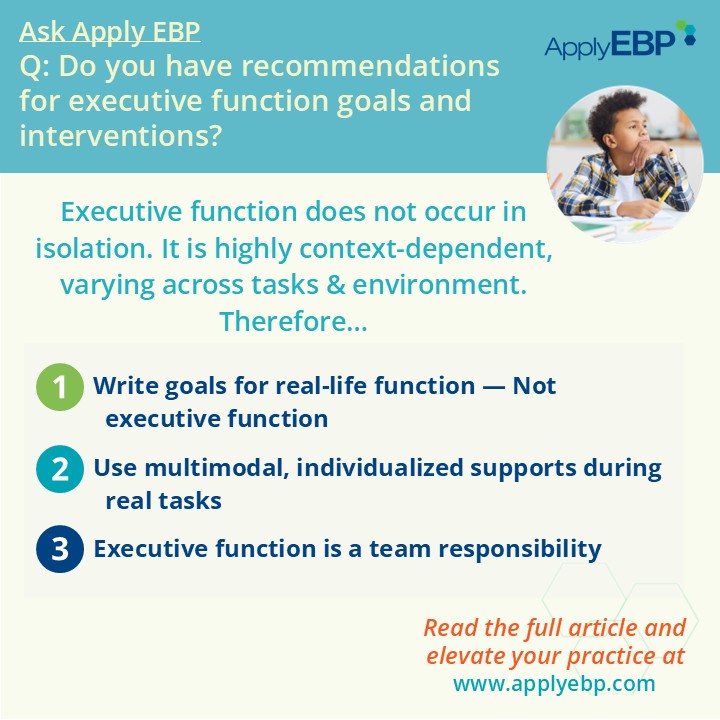
- Does not occur in isolation
- Is highly context-dependent
- Varies across tasks and environments
- Does not occur in isolation
-
It is no wonder that research shows that for children with disabilities, embedding EF support into meaningful, real-life tasks and routines, using explicit strategies and progressive challenges, appears more impactful and generalizable than stand-alone EF drills alone.(Birtwistle et al, 2025; Kirk et al, 2015; Gkora & Drigas, 2024; Napolitano et al, 2025)
So how do you put these lessons into practice?
Here are Apply EBP’s Top 3 Recommendations for Addressing Executive Functions:
1. Write Goals for Real-Life Function — Not Executive Function
Because executive function does not occur in isolation and varies across tasks, it should not be written as the goal itself.
Instead of writing these goals:
-
-
- “The student will improve task initiation”, or
- “The student will complete a 3-step activity”
- “The student will improve task initiation”, or
-
Focus on real-life goals, such as:
-
-
- Starting morning routines independently…
- Completing written assignments..
- Participating in play with peers…
- Communicating preferences during mealtime…
- Starting morning routines independently…
-
Each of these goal areas requires executive function skills, just as they may require other components such as motor skills, muscle strength, sensory processing, articulation, and language. The ultimate goal remains participation in meaningful routines.
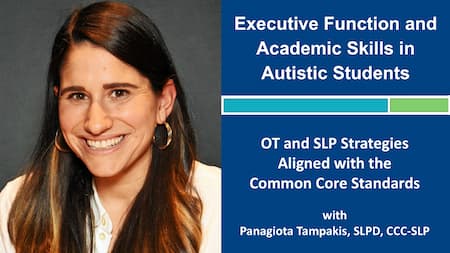
Academically, targeting standards such as the Common Core State Standards (CCSS) is another effective way to support executive functioning. As Panagiota Tampakis, SLPD, CCC-SLP shares in her seminar Executive Functions and Academic Success in Autistic Students, executive function skills are required for students to meet grade-level expectations across subjects.
For example, the 2nd grade New York writing standard, CCSS W.2.3: “Write narratives in which they recount a well elaborated event or short sequence of events, include details to describe actions, thoughts, and feelings, use temporal words to signal event order, and provide a sense of closure.”
This standard draws on multiple executive function domains:
-
-
- Planning and organization to generate ideas and sequence events
- Working memory to hold and develop the story while writing
- Self-monitoring to ensure the story makes sense and to identify errors
- And more…
- Planning and organization to generate ideas and sequence events
-
This reinforces an important point: Executive function supports performance — it is not the outcome.
2. Use Multimodal, Individualized Supports During Real Tasks
There is no single “best” executive function intervention. Research supports combining multiple approaches and tailoring intervention to the child’s needs, the environment, and participation goals.
Effective intervention may include a combination of:
-
-
- Strategy instruction
- Environmental supports
- Visual tools and checklists
- Physical activity and movement
- Classroom and routine-based supports
-
Importantly, just like our goals discussion in #1 above, these supports should be implemented during real-world activities, not in isolation.
For example, to support a student’s ability to complete written work during ELA, you might implement these multiple interventions:
-
-
- Classroom mindfulness exercise led by the teacher for self-regulation to improve focus and decrease anxiety students may experience from writing tasks
- Paragraph organizer provided to the student such as this one from Reading Rockets for organization of ideas
- Checklist for the student to self-monitor their completed work for capitalization, punctuation, and spelling
- Explicitly teaching and coaching the student how to use the above-mentioned paragraph organizer and checklist
- Additionally, outside of the writing activity, you may recommend physical aerobic activity of at least 20 minutes 3x a week (e.g., as part of PE, recess, or extracurricular), as this have also been shown to improve inhibition, working memory, and academic performance. (Greeff et al, 2017; González-Del-Castillo & Barbero-Alcocer, 2025; Liu et al, 2020)
-
3. Executive Function Is a Team Responsibility
Executive function is not a service. It does not develop via therapy sessions alone. Just like with anything else – learning requires practice, practice, and more practice.
Research highlights that involvement of teachers, caregivers, and other school staff who are present across the child’s day is essential for generalization and meaningful outcomes (Almulla &Alhaznawi, 2025; Takacs & Kassai, 2019; Duncan et al., 2024; Muir et al., 2023).
Team collaboration is important to ensure development of executive functions through:
-
-
- Repeated practice opportunities throughout the school day (and at home)
- Creation of an EF-supportive environmental structure
- Consistent adult expectations and strategies applied across different settings
-
Ready to Continue your Evidence-based Practice (EBP) Journey?
Executive function is not something we “fix” in isolation — it develops through meaningful participation in everyday tasks. When we shift our focus from targeting executive function as the end-all to supporting children in real-life activities, we naturally address the executive processes needed for success. By writing functional goals, embedding supports within real tasks, and collaborating as a team, we can create the consistent opportunities children need in building the skills they need for school, home, and beyond.
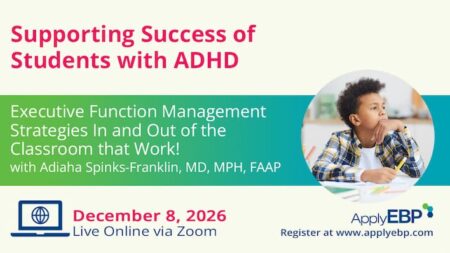
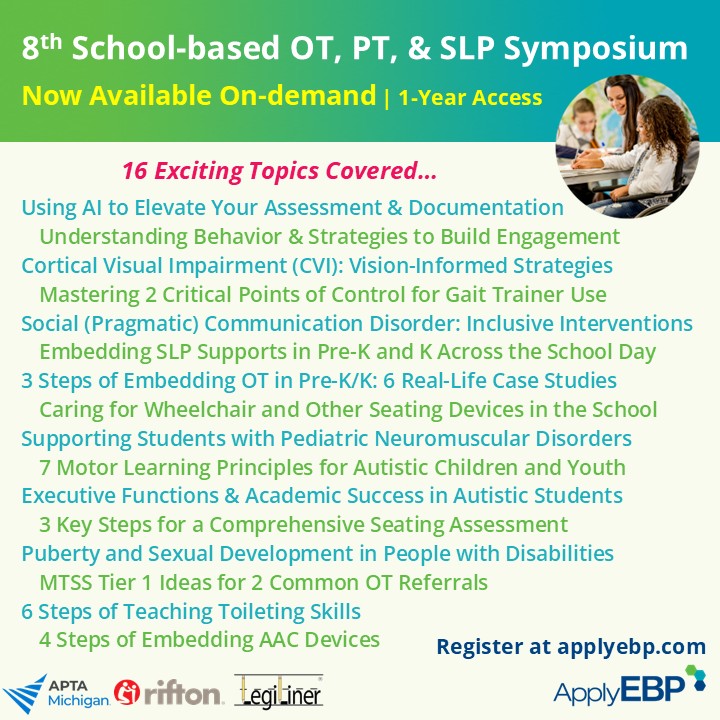
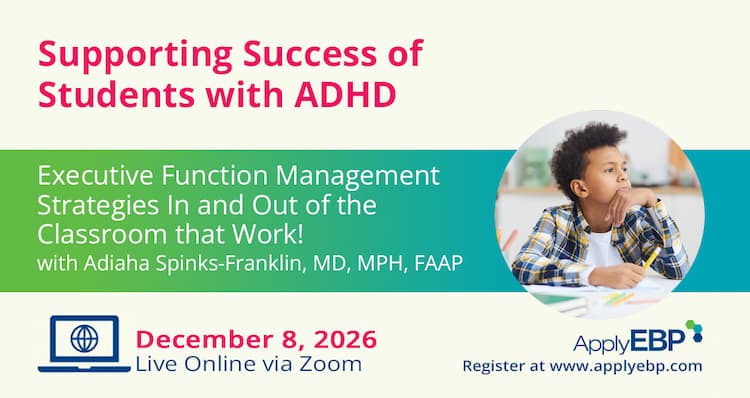
If you would like to deepen your understanding of executive functions, join…
References:
Almulla, A., & Alhaznawi, A. (2025). The Role of Executive Functioning Interventions in Supporting Students with Learning Disabilities. Journal of Posthumanism. https://doi.org/10.63332/joph.v5i5.1842.
Birtwistle, E., Chernikova, O., Wünsch, M., & Niklas, F. (2025). Training of Executive Functions in Children: A meta-analysis of cognitive training interventions. SAGE Open, 15. https://doi.org/10.1177/21582440241311060.
Gkora, V., & Drigas, A. (2024). Enhancing executive functions in children: a comprehensive review of interventions via digital technologies and future directions. Scientific Electronic Archives. https://doi.org/10.36560/17520241974.
González-Del-Castillo, J., & Barbero-Alcocer, I. (2025). Effects of school-based physical activity programs on executive function development in children: a systematic review. Frontiers in Psychology, 16. https://doi.org/10.3389/fpsyg.2025.1658101.
Greeff, J., Bosker, R., Oosterlaan, J., Visscher, C., & Hartman, E. (2017). Effects of physical activity on executive functions, attention and academic performance in preadolescent children: a meta-analysis.. Journal of science and medicine in sport, 21 5, 501-507 . https://doi.org/10.1016/j.jsams.2017.09.595.
Hendry, A., & Scerif, G. (2023). Moulding environmental contexts to optimise neurodiverse executive function performance and development: A goodness‐of‐fit account. Infant and Child Development. https://doi.org/10.1002/icd.2448.
Kirk, H., Gray, K., Riby, D., & Cornish, K. (2015). Cognitive training as a resolution for early executive function difficulties in children with intellectual disabilities.. Research in developmental disabilities, 38, 145-60 . https://doi.org/10.1016/j.ridd.2014.12.026.
Liu, S., Yu, Q., Li, Z., Cunha, P., Zhang, Y., Kong, Z., Lin, W., Chen, S., & Cai, Y. (2020). Effects of Acute and Chronic Exercises on Executive Function in Children and Adolescents: A Systemic Review and Meta-Analysis. Frontiers in Psychology, 11. https://doi.org/10.3389/fpsyg.2020.554915.
Napolitano, N., Rojas-Barahona, C., Gaete, J., & Araya, R. (2025). A comparison of three executive function interventions on direct and far transfer in Chilean school children: a cluster-randomized controlled protocol. BMC Psychology, 13. https://doi.org/10.1186/s40359-025-03075-3.
Takacs, Z., & Kassai, R. (2019). The efficacy of different interventions to foster children’s executive function skills: A series of meta-analyses.. Psychological bulletin, 145 7, 653-697 . https://doi.org/10.1037/bul0000195.
Zelazo, P., & Carlson, S. (2022). Reconciling the Context-Dependency and Domain-Generality of Executive Function Skills from a Developmental Systems Perspective. Journal of Cognition and Development, 24, 205 – 222. https://doi.org/10.1080/15248372.2022.2156515.