When most people hear the word dysgraphia, they think of messy handwriting, letters floating above the line, words squeezed together, an uncomfortable-looking pencil grip. A student who writes slowly, erases constantly, or avoids writing altogether.
And yes, those may all be signs of dysgraphia. But that’s just the surface of dysgraphia that we can see. In fact, the term dysgraphia is not used in the DSM-V. The diagnostic term is Specific Learning Disorder with impairment in written expression, which gives us a much better clue about what is really going on.
Under IDEA, it is under Specific learning disability, which means “a disorder in one or more of the basic psychological processes involved in understanding or in using language, spoken or written, that may manifest itself in the imperfect ability to listen, think, speak, read, write, spell, or to do mathematical calculations…” .
For the sake of brevity, we will interchangeably use the terms dysgraphia or SLD in written expression or SLD in WE. If you’d like to learn more about dyslexia, another SLD, read our article, Top 3 FAQs about Dyslexia and Handwriting.
To get the team on the right track in supporting students with SLD in WE, we’d like to share 3 misconceptions we often hear about, and debunk them with current evidence.
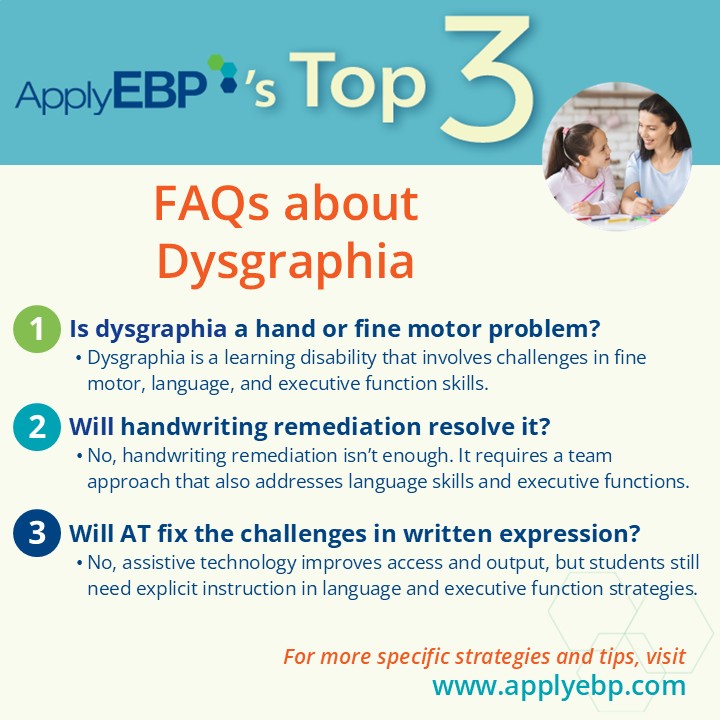
FAQ #1: Is dysgraphia a hand or fine motor problem?
Thinking that dysgraphia is just a “hand” problem is probably the most common misconception.
Because the most visible part of the writing process is a student’s handwriting, it is easy to assume the problem is in motor skills. We see inconsistent letter formation, poor spacing, and less written output compared to their peers, so, naturally, our attention is called towards their grip, hand strength, fine motor coordination, and visual motor integration.
While those matter, they are only a small part of the whole story.
The truth is that handwriting is both a brain-based and a hand-based task. In addition to the manual aspect of writing, it involves the use of language and executive function skills (e.g., attention regulation, working memory, organizing ideas), both of which are often impacted in SLD in WE. Additionally, many individuals with SLD in written expression, may also have SLD in reading (dyslexia), and ADHD, further impacting their language skills, especially on the former, and executive functions for both conditions. (Chung et al, 2020; Grigorenko et al, 2020; Ruffini et al, 2024).
Poor writers use less efficient neural pathways for idea generation, spelling, pencil control, and letter formation. They may also use more brain areas during writing, which can help explain why writing can feel exhausting for these students (Chung et al, 2020; Costa et al, 2022).
This knowledge opens the door to a much more effective intervention plan.
FAQ #2: Will handwriting remediation resolve challenges in dysgraphia?
With the knowledge above, we can now agree that handwriting remediation will not be enough for children with SLD in WE.
They require a 3-prong approach. In addition to explicit handwriting instruction, they will also benefit from language and executive function interventions (the 2 other prongs).
Language intervention may target spelling, phonological awareness, sentence construction, sentence mechanics, vocabulary, and the logical flow of ideas. This may include explicit instruction in text structure, word banks, and guided feedback from adults or peers.
Executive function intervention supports the planning, organization, working memory, and self-monitoring required for writing. Graphic organizers, checklists, writing models, paragraph frames, and step-by-step planning tools can help students know where to start, what to include, and how to check their work.
Accommodations and modifications may also be needed, such as:
-
-
- extra time
- assistive technology
- oral responses
- reduced writing demands, or
- assignments broken into smaller parts
-
These help students with SLD in WE access learning while the team also addresses their handwriting, language, and executive function skills.
Needless to say, this comprehensive intervention plan requires a team approach, with teachers, resource room instructors, as well as OT and SLP practitioners working together in varying capacities to address all aspects of written expression.
By the way, if you are looking for evidence-based interventions for handwriting remediation (1 of the 3 prongs we described above), read our article, Top 3 Effective Handwriting Interventions.
FAQ #3: Will assistive technology fix the challenges in written expression?
Assistive technology can be incredibly helpful.
Typing, speech-to-text, word prediction, spellcheck, and other tools can reduce the physical and emotional load of writing. Assistive technology allows them to produce more work, demonstrate what they know, and participate more successfully in class.
But assistive technology does not automatically address higher level writing difficulties, such as language and executive function challenges.
-
-
- Typing does not teach a student how to organize an argument
- Speech-to-text does not automatically create a logical paragraph
- Spellcheck does not teach sentence structure or grammar
- Word prediction does not teach a student how to plan, sequence, or monitor their ideas
-
So yes, give the student the tool to support access, learning, and school productivity. But do not stop there.
Continue to provide explicit instruction in language and executive function strategies, like the ones we described above. For example, before typing a paragraph, a student may need a graphic organizer to plan it, choose vocabulary from a word bank, write a draft, compare it to a model, and use a checklist to see whether their end-product is in line with the expected output. Additionally, don’t forget to provide explicit instruction and practice on the effective use of the provided assistive technology.
Assistive technology can be part of the plan. It just cannot be the whole plan.
Ready to continue your EBP journey?
Want to learn more about specific learning disability in written expression, aka dysgraphia, and effective handwriting interventions, check out…
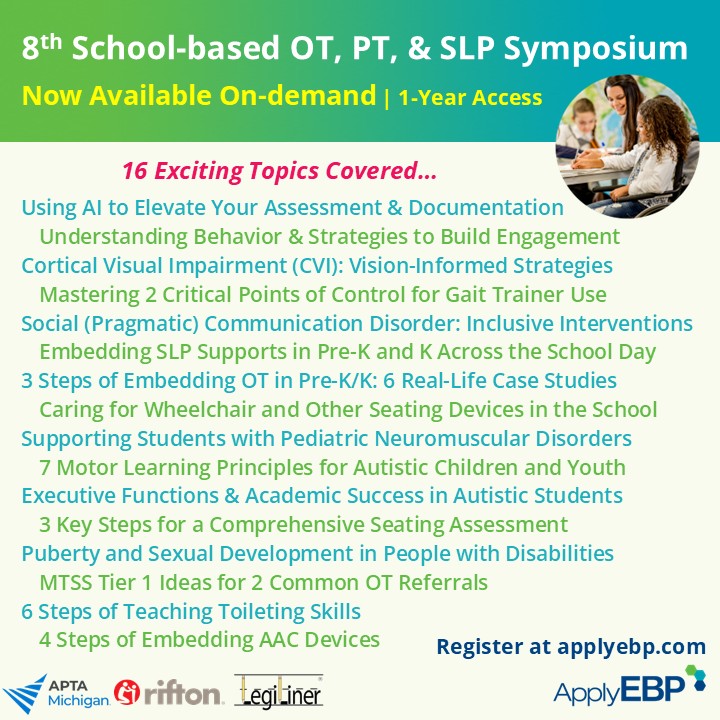
If you would like to learn more about other school-based topics…





References:
-
-
- Chung, P. J., Patel, D. R., & Nizami, I. (2020). Disorder of written expression and dysgraphia: definition, diagnosis, and management. Translational pediatrics, 9(Suppl 1), S46.
- Costa, L. J. C., Spencer, S. V., & Hooper, S. R. (2022). Emergent neuroimaging findings for written expression in children: a scoping review. Brain Sciences, 12(3), 406.
- Grigorenko EL, Compton DL, Fuchs LS, Wagner RK, Willcutt EG, Fletcher JM. Understanding, educating, and supporting children with specific learning disabilities: 50 years of science and practice. Am Psychol. 2020 Jan;75(1):37-51. doi: 10.1037/amp0000452. Epub 2019 May 13. PMID: 31081650; PMCID: PMC6851403.
- Ruffini, C., Osmani, F., Martini, C., Giera, W. K., & Pecini, C. (2024). The relationship between executive functions and writing in children: a systematic review. Child Neuropsychology, 30(1), 105-163.
- Salas, N., & Silvente, S. (2020). The role of executive functions and transcription skills in writing: A cross-sectional study across 7 years of schooling. Reading and Writing, 33(4), 877-905.
- Watson, S. M., Michalek, A. M., & Gable, R. A. (2016). Linking executive functions and written language intervention for students with language learning disorders. International Journal of School and Cognitive Psychology, 3(3).
-