
Q: “What should I have in my bag when I go to embed my services?”
We posed this question to our Apply EBP Instructors to gather their expert insights. We hope you find their recommendations helpful as you try out and continue to refine your embedded practice.
“When I embed, I carry my planner/notebook and sticky notes. I make sure to write down my observations and any questions I have for the teacher or student that I want to follow up on. I also use sticky notes to support students and teachers in the moment.” – Lara Collins Barros, OTD, OTR/L, Instructor of “3 Steps to Successful Embedding of OT Services”
“As a physical therapist, when I provide embedded supports to students in school, I don’t initially bring any ‘things’ with me. I start with taking in what the environment is like first. Where does the student need support? What activities does the student need to perform in order to participate with their peers or to complete the task/goal? Then I see what ‘things’ are already being used in that environment. Does the student need to address transfers in the classroom, cafeteria, or restroom? If so, I use the real life furniture that the student needs to ultimately transfer to for training, practice, and carryover during my service time with them. Does the student need to participate in PE class with peers? If so, then I attend PE with the student and utilize the items being used in the class activity that day to provide training, practice, and carryover for days when I am not there. I learned long ago that if I bring certain toys or items in to use in my service time, the students tend to associate the activity with that specific item and carryover was not as good. It also makes it a lot easier on me to no longer carry a bag of ‘things’ around with me from building to building every day. Going ‘bagless’ has been a great experience for me and has allowed me to embed my services by becoming part of the regular school environment.” – Jen Wissinger, PT, DPT, Instructor of “Using Routines as a Therapy Tool”
“For me, embedding services means I am joining the activities the teacher has planned for the class! I rarely bring anything with me other than some visual cues that are always clipped on my badge. When I’m in the room, I join the children using appropriate strategies to target their goals, pushing in language, encouraging peer interactions, and coaching the teacher when possible. If I have the opportunity to join the teacher for some brainstorming and planning, I may bring an adaptive book and leave it behind for the class to continue using after I leave. Having open and frequent communication with the teacher is most important and checking in on what’s working and what we can improve upon.” – Beth Gardner, MA, CCC-SLP, Instructor of “4 Steps of Embedding AAC in Daily Routines”
“I was not one to take a bag with things to visit other than my trusty journal book that I wrote everything down in, my business card and a tape measure. I wore a lanyard with PECS symbols for things like sit, stand, walk etc. typical commands or requests that we as PTs might make with students. Very helpful in PE class. Once I had a plan for how to address a challenge, these things often accompanied me to mitigate that challenge in the classroom:
-
-
- Painters tape or other colored tape to assist with spatial awareness
- My phone with the tape measure app and timer ( good for transitions)
- Move and sit cushion for postural support, student alertness/engagement
- Pool noodles for support in a variety of equipment( stander, gait trainers, chairs)
- Carpet squares for spatial awareness( floor activities_
- Adapted toys for rec/leisure or centers( with lights or music if the teacher had told me the student responds well or is motivated by that)
- Cardboard box- either to use for feet and assist with posture or to place under a wheelchair tray to make it higher to support the UEs”
– Sue Cecere, PT, MHS, Instructor of “Supplementary Aids and Services”
-
“Patience & flexibility are tools in my embedding bag of skills. Patience & flexibility are critical because we are not in charge of the students’ daily routines and schedules. There will be times when we show up to a classroom, and the learning plan has changed. Stay. The third item is being able to roll with the flow AND make it the most productive for the student as we can. When that learning plan has changed, we show up to class anyway; don’t skip the opportunity to be in the classroom, there is so much about curriculum and school culture to be learned by staying. School-based related service providers are professionals, equipped with seasoned clinical reasoning skills to support students in their curricular activity of the moment.” – Peggy Morris, OTD, OTR/L, BCP, Instructor of “Strengths-based Application of Sensory Processing Assessment”
“The only thing I might bring with me is a gait belt. Embedding your services is about helping the child participate in the SAME activities as their peers, not doing something different off to the side. For instance, on the last day of school, there was a big “field day.” This included inflatable obstacle courses, games outside, and time on the playground equipment. I used the gait belt to help a student with CP complete as much of the inflatable obstacle course as he could. I also used the gait belt to help him transfer into a swing on the playground. I would also perhaps use a gait belt to embed transfer training into routine tasks that are occurring every day, such as toileting and changes.” – Erika Hanson, PT, Instructor of “6 Effective Strategies for Fading Adult Assistance”
“When providing embedded services, my bag of physical items is minimal to non-existent depending on the unique situation. Anything brought into the classroom or other school environment is intentional, necessary, and feasible for students and/or adults to implement within their daily routines. Instead of physical items, my focus is primarily on my own mental readiness to provide embedded services and utilize my unique knowledge, expertise, and training as an occupational therapist. This includes leveraging and applying a growth mindset, therapeutic use of self, professional reasoning, and a transactional perspective of the person, environment, and occupation into the educational setting. For example, a transactional perspective is beautifully aligned to the key domains of learning: instruction, curriculum, environment, and learner. Thus, before, during, and after an embedded session, I frequently reflect on the question: What enhancements and/or adjustments can I contribute to support the instruction, curriculum, environment, and/or learner in this specific context? Ongoing preparation, flexibility, persistence, problem-solving, application of our unique lens, and collaboration is critical to the success and effectiveness of embedded services!” – Bridgette LeCompte, MS, OTR/L, Instructor of “Multi-tiered Systems of Support”
“I love providing embedded services because I feel like it’s how I can help not just the student on my caseload but potentially the whole class! I go in armed with a pro-active mindset, online resources (Fit4Work website, justadaptit.com, online yoga). I always begin with what the students need, what the student’s goals are and what is already in the classroom. Objective things in the bag to do a Fit4Work Screen include a pulse oximeter, tape measure and milk crate. Items that I might need at the job site might be adapted cleaning tools (e.g., long-handled sponge, sponge mitt, gardening kneeling pad for knees, colored tape to mark handles and floor placemarkers).” – Connie Johnson, PT, DScPT, YRT 200, Instructor of “Fit4Work”
“I don’t bring a therapy bag with special toys or materials when I embed my services. Instead, I intentionally use what’s already part of the environment—lines on the floor, carpet squares, letters on rugs—common features in preschool and elementary spaces. I get creative with what’s naturally available so the student can participate alongside their peers. By following the existing routines in the classroom, gym, playground, or other school settings, my support feels natural, helps staff understand my role as a school-based PT, and makes it easier to provide consistent support even when I’m not there.” – Karen Tartick, PT, Instructor of “Embedding PT Services in General Education Classrooms”
Ready to Embed?!
If you would like to learn more about how to embed your services into the school routines, read our article “5 Skilled Services We Can Provide When Embedding in the Student’s Real-life Environment“.
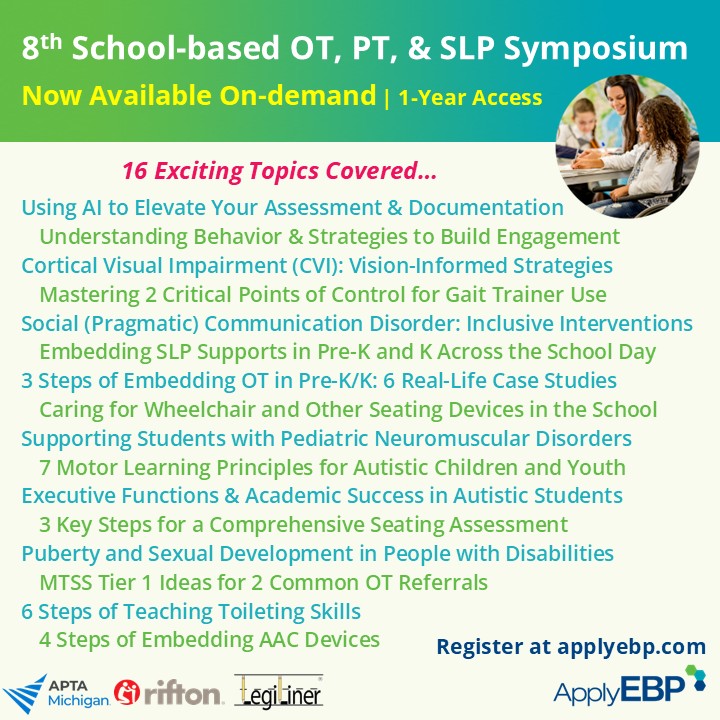
And if you are interested in more evidence-based tools, strategies, and discussions about school practice, join…
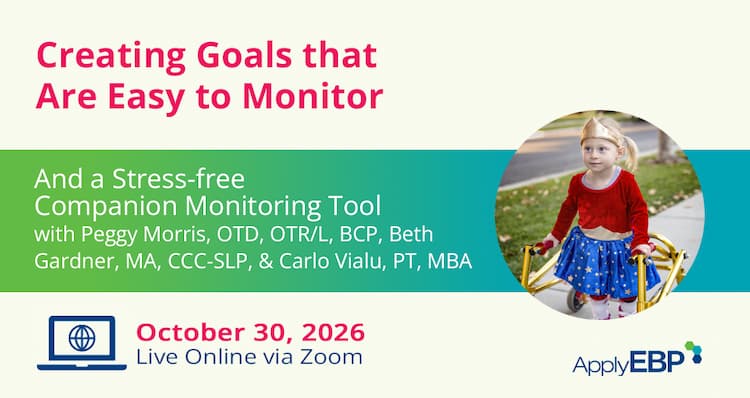

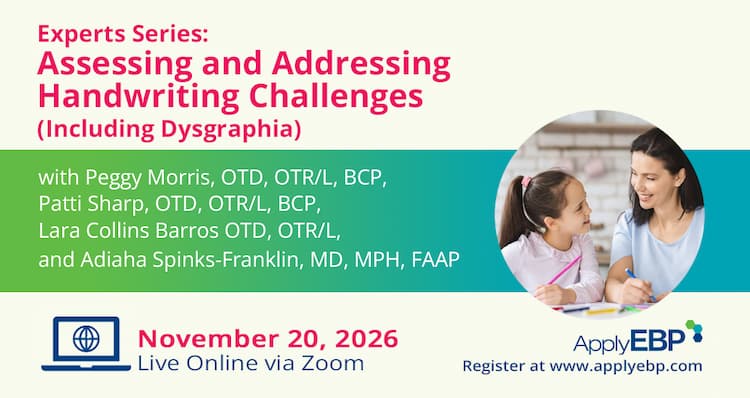
Or these webinars…