Q: Why Don’t My Students’ Goals Reflect the Progress I See?
When we write goals like:
-
-
- “The student will complete a visual-motor activity (e.g., maze, dot-to-dot) with 90% accuracy in order to write a paragraph consisting of at least 3 sentences…”
- “The student will demonstrate improved strength and balance to be able to play with peers on the playground…”
- “The student will correctly produce the /r/ sound in the initial, medial, and final positions of words with 90% accuracy during structured speech tasks in order to improve classroom communication…”
-
—we might think we’re setting clear, measurable objectives.
But in reality, these goals can keep both us and the children we serve in a loop—where progress is hard to measure, and services continue without a clear end in sight.
Here are 3 reasons why:
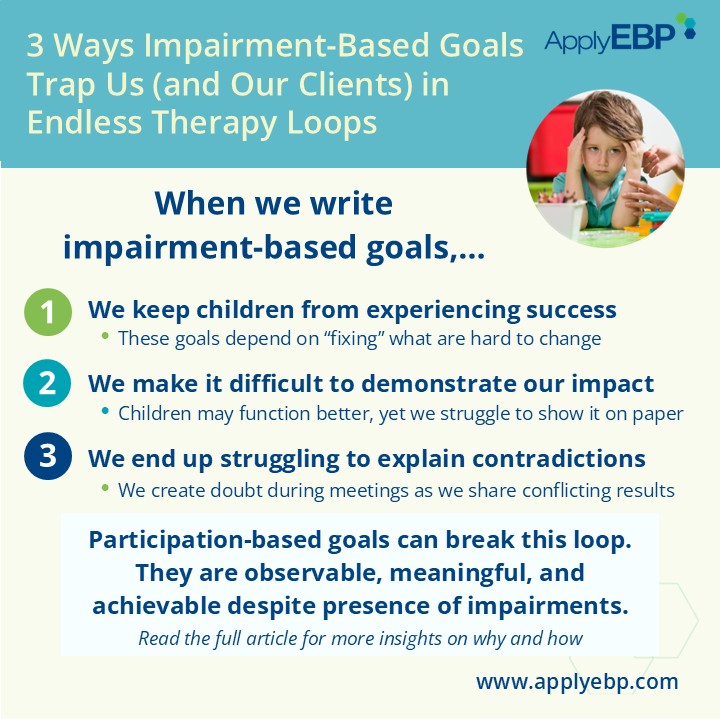
1. We Keep Our Students from Experiencing Success
Many children and youth with disabilities have impairments that are lifelong or slow to change. Even when improvement happens, it doesn’t always lead to better real-world function (Novak et al, 2020; Rosenbaum, 2020).
When our goals depend on impairments resolving—like higher visual motor scores or mastering perfect balance—we unintentionally set students up for failure.
Imagine how discouraging it must feel to keep working on your “weaknesses,” only for our pediatric clients and their families to see little measurable change. Instead of celebrating progress in writing, playing, or communicating, we’re measuring them by what hasn’t changed.
2. We Make It Difficult to Demonstrate Our Impact
When goals are written at the impairment level, the data we collect doesn’t always reflect the real growth we see every day.
Our students may be:
-
-
- writing more legibly,
- participating with peers during recess, or
- confidently reading aloud—
-
…but if test scores for visual-motor integration, balance, or articulation haven’t improved, it looks like nothing has changed.
When it’s time to report progress, we end up experiencing that “sinking” feeling—knowing that children are improving functionally, yet struggling to show it on paper.
3. We End Up Struggling to Explain Contradictions
When function improves but the test scores don’t, we’re suddenly caught explaining the mismatch. That same sinking feeling turns into visible doubt during meetings as we share conflicting results. Others may start to question progress—or assume the child still “needs therapy.”
And in that moment, we lose the opportunity to share with confidence that the student is actually progressing so well that they may need less of our services. Instead, we end up stuck in an endless service loop—defending our work rather than celebrating the student’s growing skills and independence.
The Good News: There Is an Easy Alternative
Participation-based goals can break this endless cycle. How?
-
-
- Participation-based goals reflect what truly matters: the child’s ability to engage in real-life routines;
- They focus on observable, meaningful outcomes that teachers, parents, and team members can actually see; and
- They are achievable despite the continued presence of impairments at the body function and structure level.
-
The Other Good News: You Are Almost There
Remember our 3 examples above? As one participant in our Creating Goals That Are Easy to Monitor course put it: “These goals are trying to be participation.”
And that’s exactly right. Ready to turn your impairment-based goals into participation-based ones? Here are 2 easy suggestions
-
-
- Eliminate the phrases before the participation part.
- For example
- “The student will
complete a visual-motor activity (e.g., maze, dot-to-dot) with 90% accuracy in order towrite a paragraph consisting of at least 3 sentences…” - “The student will
demonstrate improved strength and balance to be able toplay with peers on the playground…”- You can then add conditions and elements in suggestion #2 below
- “The student will
- For example
- Use our 4 WH of Participation-based Goals worksheet to add necessary elements.
- For example,
- You already know the need to eliminate the non-participation part in this goal: “The student will correctly produce the /r/ sound in the initial, medial, and final positions of words with 90% accuracy during structured speech tasks in order to improve classroom communication…”
- Now add the 4 Elements:
- WHAT is the real-life task? For example, it can be reading, communicating need, or asking questions
- WHEN does it take place? During ELA
- WHERE does it take place? In the classroom (this one’s already in the goal!)
- WHO is around when it takes place? Classmates
- For example,
- Eliminate the phrases before the participation part.
-
Final Thoughts
When we shift from impairment-based to participation-based goals, we stop digging rabbit holes—for ourselves and for the children and youth we serve.
We help our students and their families experience success, we make our impact visible, and we bring clarity and confidence back into our reporting and recommendations.
If you’d like to explore school-based topics, join us for…

Creating Goals: 1.5-hour webinar
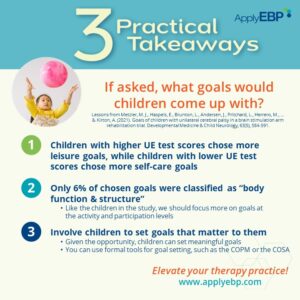
Curious what goals children typically come up with? Read “If Asked, What Goals Would Children Come Up With?“