Q: I’m spending too much time writing and editing school-based speech goals. Does anybody have a good resource?
What’s the longest time you spent staring at your computer, typing, deleting, writing, and rewriting the same school-based speech goal? You’re trying to write something individualized and functional for your student’s IEP, but you’re stuck. Or, after crafting what you thought were good goals, you realize, there’s no way you can measure the student’s progress on these goals.
OT and PT practitioners, this is for you too! See examples at the end of this article to demonstrate application of the same approach for fixing goals.
Good News: Don’t Delete Your Goals!
Pause! Before you hit “backspace” one more time, let’s reflect on what you already have. You are likely on the right track and don’t have to completely rewrite the goals.
Often, a few small changes can make a goal more meaningful and help the entire educational team support the goal and measure progress.
Instead, read the goal and ask:
-
-
- Would the team know what to listen or watch out for?
- Would the team know when and where they should encourage it?
- Would the team know what success looks like?
-
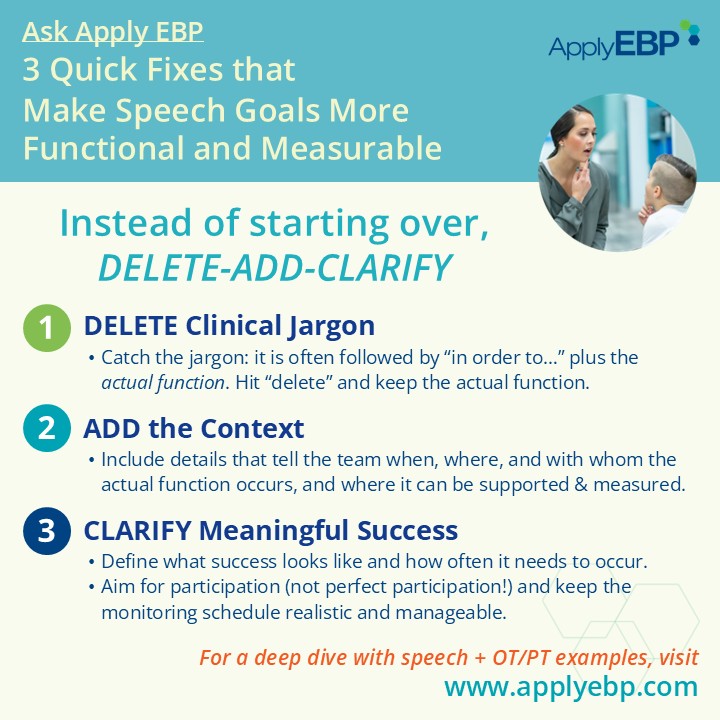
If you answered “NO” to any or all the above questions, then the goal is likely NOT functional and easy to measure. Or, as Peggy, Beth, and Carlo would say in the course Creating Goals that Are Easy to Monitor, “the goal is NOT YET”…indicating that you are almost there! Just follow these 3 small changes: Delete – Add – Clarify!
Step 1: Delete Clinical Jargon
Some words make sense to us, therapy practitioners, but not to educators, families, and other team members. Review your goals and find these clinical jargons and start hitting “delete.”
-
-
- Words or phrases like: phonological process, pragmatic language, oral-motor skills, expressive language
-
These clinical jargons can be hiding in plain sight in the beginning of goals, often followed by “…in order to…” plus the actual function that other team members can understand and observe. Hit “delete” and keep the actual function!
Let’s try it out with 2 case vignettes.
Case #1: Graham is a 7-year-old student with lingering phonological processes, including cluster reduction. He successfully produces /s/ in CVC words, but production of /s/ blends is still emerging. He loves engaging with peers, but becomes frustrated when they don’t understand his speech during classroom activities.
-
-
- The current version of his goal starts with “Graham will reduce the phonological process of cluster reduction by producing /s/ blends…”
- Delete: “will reduce the phonological process of cluster reduction”
- That’s just the technical description of what happens when Graham can correctly “produce /s/ blends” – the observable aspect of his verbal communication.
- The current version of his goal starts with “Graham will reduce the phonological process of cluster reduction by producing /s/ blends…”
-
Case #2: Johnny is a 15-year-old high school student, diagnosed with autism and ADHD, who is highly motivated to engage with peers, especially in small-group settings. However, his peers often report that he is distracting during group activities because he frequently goes off-topic. During 10- to 15-minute small-group activities, Johnny is redirected 3-4 times by the teacher to return to the topic and task at hand.
-
-
- The current version of his goal starts with “Johnny will improve pragmatic language in order to contribute information or ask questions relevant to the assigned topic…”
- Delete: “improve pragmatic language in order to”
- Yes, the team wants Johnny’s “pragmatic language” skills to progress so he can be successful in group activities, but it is a totally unnecessary jargon, because “…will contribute information or ask questions relevant to the assigned topic…” is the actual function that demonstrates that improvement.
- The current version of his goal starts with “Johnny will improve pragmatic language in order to contribute information or ask questions relevant to the assigned topic…”
-
The examples above have the actual function in the goal already; but, there will be times when the “actual function” is completely missing. In which case, replace the clinical jargon with everyday language. When goals use everyday language and connect to authentic school function or activities, they become more than “the speech goal.” The entire team can see its role in supporting the student’s communication and recognize progress along the way.
Step 2: Add the Context
Real function does not occur in isolation! And this is nowhere more true than in speech and language skills. If we want to see our impact as SLP/As, we need to be able to describe and measure how they will be using their language and communication skills in real life.
So…add the context! Include details that tell the team when, where, and with whom the student will use the target skill.
-
-
- When, where, and with whom will Graham “produce /s/ blend words”?
- When: During games and language activities
- Where: Classroom
- With whom: Teacher, peers
- When, where, and with whom will Johnny “ask relevant questions”? For example:
- When: During group work
- Where: Do you want to indicate a particular class?
- With whom: Classmates
- When, where, and with whom will Graham “produce /s/ blend words”?
-
For a free goal worksheet, see our article: 4 WH Questions/Elements of Participation-based Goals
It’s easy to get carried away when adding context. So, here are 2 quick tips:
-
-
- If the actual function can occur in multiple settings, narrow the when/where by asking:
- When and where does this function occur most often? This may make it easier to observe and support.
- When and where is the student having the greatest difficulty? This may be where improvement is most needed.
- You don’t always need all 3 (when, when, with whom). Use only what is needed.
- Sometimes, indicating the when implies the where (e.g., during mealtime implies lunchroom; during classroom games makes the location clear)
- If the actual function can occur in multiple settings, narrow the when/where by asking:
-
There’s also an important side benefit to “Adding the Context.” We know that one speech session each week is not enough to build lasting communication skills. Students spend many more hours in classrooms, cafeterias, playgrounds, and other school routines, interacting with peers, teachers, and others. By identifying when, where, and with whom a skill will be used, we give educators and families more opportunities to model, encourage, and reinforce the target skill throughout the day.
Step 3: Clarify Meaningful Success
What does it look like when the student has achieved the goal? When can you and other team members say that, “Yes! Johnny is doing this now!”?
If you followed the Delete-Add steps above, you’ve already done most of the work. But some clarification may still be needed to define the success criteria. This final step often requires determining in what manner (e.g., assistance needed) and how frequently the student needs to perform the actual function to call it a success.
Once again, it’s easy to get carried away in this step. So here are 3 tips:
-
-
- Relate it back to the student’s baseline.
- What is the student’s previous performance? And which aspect of the performance is meaningful and can be measured most easily?
- For Graham, producing /s/ blend words is just emerging. So it can be the number of words that were correctly produced.
- For Johnny, it can be the number of redirections, which is currently at 3-4 times per observation.
- What is the student’s previous performance? And which aspect of the performance is meaningful and can be measured most easily?
- Aim for participation, not perfect participation!
- Why are classmates allowed to make mistakes or have a bad day, while our students are not?
- For Johnny, is requiring up to 1 verbal redirection to stay on topic during a 15-minute group activity acceptable? Don’t teens (and adults too!) get distracted, sidetracked, or go off-topic at times?
- Consider the observer’s burden of monitoring success.
- Before deciding how often monitoring will be, ask these 3 questions:
- How often does the actual function occur in real life?
- Note! The more it occurs, the more frequently it can be practiced and observed.
- What is a realistic timeframe for the student to show improvement?
- Use your clinical reasoning! Monitoring too frequently may not allow enough time for meaningful change, creating unnecessary work measuring something that has not been given enough practice to change.
- For example, use what you now know about Johnny’s baseline performance, medical and educational history, and how frequently the actual function occurs, and therefore can be practiced, to determine a reasonable interval for expecting improvement.
- What is a realistic observation schedule for the person monitoring the goal?
- For example, if you are the one monitoring the improvement, how often can you realistically observe whether Graham is producing /s/ blend words correctly: every day, once a week?
- If another team member is monitoring success, discuss what is realistic for them.
- How often does the actual function occur in real life?
- Before deciding how often monitoring will be, ask these 3 questions:
- Relate it back to the student’s baseline.
-
Final Tip: There Is No Such Thing as a Perfect Goal!
Here are the participation-based goals for our 2 case vignettes:
-
-
- Graham will correctly produce 2 words that start with an /s/ blend during classroom games or language activities in 4 out of 5 observations a month.
- During a 10- to 15-minute small group activities, Johnny will contribute information or ask questions relevant to the assigned topic, with up to 1 verbal redirection when off-topic, in 3 out of 4 observations a month.
-
Can we still improve the goal above? Maybe, maybe not! But don’t get stuck trying to create the perfect goal. Instead, evaluate your goal by asking:
-
-
- Is the goal free of jargon?
- Does it include participation elements?
- And, can it be measured through observation by any relevant team member?
-
Now it’s your turn to go back to your draft goal. Review it, then use the Delete-Add -Clarify strategy!
Need More Strategies to Up Your Goal Setting Skills?
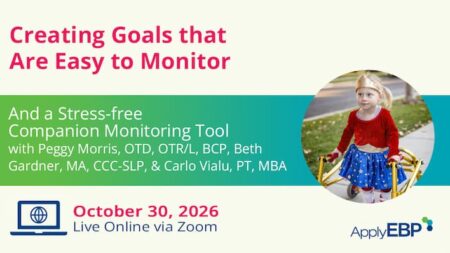
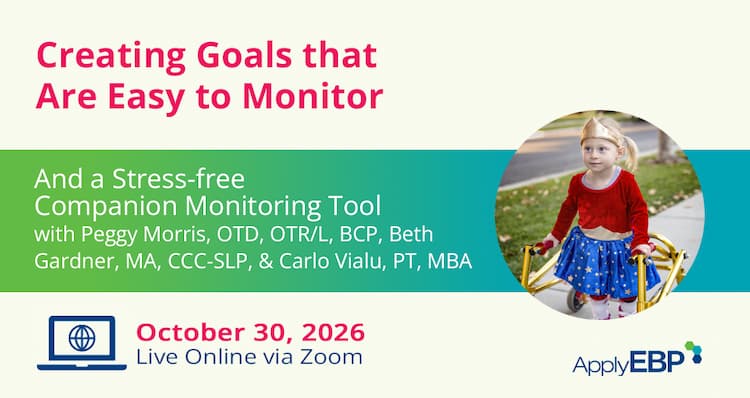
Join Peggy (OT), Beth (SLP), and Carlo (PT) in Creating Goals that Are Easy to Monitor on October 30, 2026 and learn:
-
-
- Why the “SMART goals” strategy often lead us to writing goals that are too complex to measure
- 4 Strategies to make SMART goals easier to monitor
- How to create goal monitoring tools that help you decide whether it’s time to
- Continue with your interventions
- Change your intervention
- Or change the goal
-
With lots of examples and practice time to work through speech and language goals during the day!
The Same Approach Work for OT and PT Practice!
Here are examples of OT- and PT-related goals transformed into functional and measurable student goals:
-
-
- OT-Related Goal that Needs a Quick Fix: The student will complete a visual-motor activity (e.g., maze, dot-to-dot) with 90% accuracy in order to write a paragraph consisting of at least 3 sentences.
- DELETE: complete a visual-motor activity (e.g., maze, dot-to-dot) with 90% accuracy in order to
- ADD: During journal writing time? Or indicate another place and/or time that’s best to observe this improvement in real life.
- CLARIFY: With 80% legibility or readability? When read by teacher or by another adult? Does it make it easier to gather X number of writing samples per month and count legible versus illegible words?
- The student will write a paragraph consisting of at least 3 sentences with 80% legibility in 2 out of 3 writing samples per month.
- PT-Related Goal that Needs a Quick Fix: The student will improve balance and strength to be able to walk the hallway using a walker.
- DELETE: improve balance and strength to be able to (note here that “to be able to” is similar to our clue phrase of “in order to”)
- ADD: Classroom to the lunchroom? Classroom to gym? Walking with classmates?
- CLARIFY: Same pace as peers or in X amount of time? Is assistance or supervision needed? Do you want to indicate distance?
- The student will independently walk a busy hallway with a walker from classroom to gym (~250 ft) at the same pace as peers.
- OT-Related Goal that Needs a Quick Fix: The student will complete a visual-motor activity (e.g., maze, dot-to-dot) with 90% accuracy in order to write a paragraph consisting of at least 3 sentences.
-
Ready to Continue Your EBP Journey?
If you want to learn more about best practices for the school setting, join…