
Apply EBP’s “Research Roundup” is a blog post series that serves as your go-to resource for peer-reviewed studies focusing on commonly-discussed topics relevant to OT, PT, and SLP practice. Each installment provides you a compilation of published research to inform your decision-making and to share with your team.
Q: Do stability balls for classroom seating improve behavior?
In this edition of Ask Apply EBP, we present an array of research studies on the effectiveness of stability balls for classroom seating. While we provide a concise summary of the overall findings in our Big Picture Summary, we encourage you to delve into the individual articles that pique your interest for a deeper understanding.
We provide key excerpts or insights from each study. All the studies we reference are sourced from peer-reviewed journals and are arranged from the most recent to the oldest. We included only studies delivered in a classroom setting, and excluded those conducted in a clinic or therapy setting.
Want a PDF Document version of this list that you can easily share with your team via print or email? Join Apply EBP’s Facebook Discussion Group by clicking here to download one.
We are committed to maintaining the relevance of this resource. If you have additional peer-reviewed research to contribute, please email it to applyebp@gmail.com with the subject “For Research Roundup” and the topic (e.g., For Research Roundup: Stability Balls for Seating).
Thank you for your participation!
The Big Picture
-
-
- There are numerous studies across prekindergarten through 6th grade, and that included students with typical development, or with different conditions, such autism, ADHD, dyslexia, and Down syndrome. Most studies included a small number of subjects (5 or less), which impacts the ability to generalize the results.
- Outcomes measured: Most measured the ability to be on-task and stay in-seat; some looked at other behaviors (e.g., stereotypy) or skills (e.g., reading comprehension, legibility).
- Results: Outcomes are mixed. Many studies (~60%) showed significant improvements in behaviors (mainly, on-task and in-seat), 8 of which have small Ns (<20 subjects). About 40% of the studies showed no significant improvement or a regression, including 4 with larger Ns (20-64) .
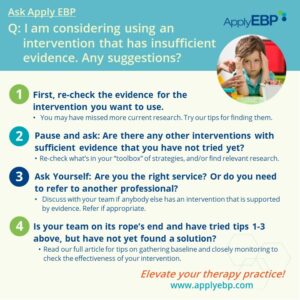
- Our take: The mixed results imply caution when recommending stability balls for seating – a “Yellow” light intervention, if we were to use the Traffic Light analogy by Novak et al (2020). The Yellow light is used when “conflicting findings exists and therefore it is unclear how a patient might respond” (Novak et al, 2020). As such, we suggest reading the Apply EBP article “4 Tips When Considering Interventions with Insufficient Evidence”. Two tips from the article as applied to the use of stability balls, include:
- Before introducing a stability ball for seating, check if there are other interventions that are better supported by evidence (i.e., Green light) to help students reach the desired outcome, and trial those first.
- If you decide to introduce a stability ball for seating, tailor the use to the student’s needs and closely monitor whether it leads to the desired outcome.
- Before introducing a stability ball for seating, check if there are other interventions that are better supported by evidence (i.e., Green light) to help students reach the desired outcome, and trial those first.
- There are numerous studies across prekindergarten through 6th grade, and that included students with typical development, or with different conditions, such autism, ADHD, dyslexia, and Down syndrome. Most studies included a small number of subjects (5 or less), which impacts the ability to generalize the results.
-
Studies from Peer-Reviewed Journals
Hulac, D., Mickelson, L., Briesch, A., Maroeca, H., Hartjes, C., Anderson, K., & Ederveen, K. (2020). Stability Balls and Student on-Task Behavior. Journal of Behavioral Education, 31, 543–560. https://doi.org/10.1007/s10864-020-09412-3
-
-
- N=24, 3rd Graders, within-subjects design
- “The results of this within-subjects design suggest that when all students are sitting on stability balls, they are on-task less frequently than when all students are seated on conventional chairs.”
-
Metz, A. E., DeMarco, M., Khalsa, A., Kreuz, N., Stock, R., & Westfall, A. (2020). The effects of ball chair seating during an instructional period in first grade classrooms. Journal of Occupational Therapy, Schools, & Early Intervention, 13(4), 395-409.
-
-
- N=30, 1st Graders, within-subjects design
- “There were differences in undesired behaviors: each switch to ball chairs was accompanied by a nonsignificant decrease in undesired behaviors, but the increase in undesired behaviors switching back to standard chairs was significant (p =.004). There was no difference in the proportion of time spent productively (p =.723). The effect on legibility suggests that if the desired outcome is improved legibility, using ball chairs may not serve as an effective intervention.”
-
Reyneke, L., & Hoosain, M. (2020). Dynamic Seating in Learners with Down’s Syndrome in South Africa. South African Journal of Occupational Therapy.
-
-
- N=3, 11-12 years old, Down syndrome, single subject design
- “…stability ball seating had a positive influence on learners’ engagement-on-task in the short-term; and greater benefit was seen in the participant with the lower baseline.”
“It was also noteworthy that the first intervention phase appeared to have the most prominent effect for each of the participants. While the latter intervention phases still exhibited an immediate and substantial improvement to behaviour, the effects were less pronounced.”
-
Macphee, F. L., Merrill, B. M., Altszuler, A. R., Ramos, M. C., Gnagy, E. M., Greiner, A. R., … & Pelham, W. E. (2019). The effect of weighted vests and stability balls with and without psychostimulant medication on classroom outcomes for children with ADHD. School Psychology Review, 48(3), 276-289.
-
-
- N=64, 5-12 years old, ADHD, 2×3 within-subjects design
- With medication (methylphenidate): x 3 conditions (stability ball, weighted vest, control)
- With placebo: x 3 conditions (stability ball, weighted vest, control)
- “Overall, results indicated that medication but not weighted vest nor stability ball interventions resulted in improvement in two key areas of functioning in school settings: following classroom rules and academic productivity.”
- N=64, 5-12 years old, ADHD, 2×3 within-subjects design
-
Olson, N. A., Panahon, C. J., & Hilt-Panahon, A. (2019). Investigating the effects of stability balls on classwide student behavior and academic productivity. Journal of Applied School Psychology, 35(3), 201-214.
-
-
- N=20, 2nd Graders, within-subjects design
- “Similar patterns of responding for on-task and out-of-seat behavior were found while students were seated on traditional chairs and stability balls. Results demonstrated similar rates of improvement in writing fluency over the course of the study.”
-
Piragasam, G. A., Rabi, N. M., & Masnan, A. H. (2018). The use of sensory balls in the classroom: effects on behavioural and academic functioning of students with learning disabilities. International Journal of Academic Research in Business and Social Sciences, 8(4), 1143-1166.
-
-
- N=8, 8-12 years old, ADHD and/or Autism, within-subjects design
- “Sensory balls did not show marked improvement over intervention phases for on-task and on seat behaviours…However, out-of-seat behaviour did improve while students were seated on sensory balls in comparison to classroom chairs.”
-
Taipalus, A., Hixson, M., Kanouse, S., Wyse, R., & Fursa, S. (2017). Effects of therapy balls on children diagnosed with attention deficit hyperactivity disorder. Behavioral Interventions, 32, 418–426. https://doi.org/10.1002/BIN.1488
-
-
- N=4, 3rd-4th Graders, ADHD, single subject design
- “No effect of the therapy balls was found, although students preferred sitting on the therapy balls.”
-
Sadr, N., Haghgoo, H., Samadi, S., Rassafiani, M., Bakhshi, E., & Hassanabadi, H. (2017). The Impact of Dynamic Seating on Classroom Behavior of Students with Autism Spectrum Disorder. Iranian Journal of Child Neurology, 11, 29–36. https://doi.org/10.22037/IJCN.V11I1.11193
-
-
- N=15, Autism, within-subjects design
- “Significant increases in in-seat behaviors in 86.7% (thirteen out of 15) of the students and on-task behaviors in 53.3% of the students (eight out of 15) when seated on therapy balls. Air cushions had no significant effects on in-seat/on-task behaviors. The results also showed significant decrease in stereotyped movement and increase in communication and social skills of these students.”
-
Gaston, A., Moore, S., & Butler, L. (2016). Sitting on a stability ball improves attention span and reduces anxious/depressive symptomatology among grade 2 students: A prospective case-control field experiment. International Journal of Educational Research, 77, 136-142.
-
-
- 3 Classrooms, 2nd Graders, prospective matched case-control design
- Control: n=18 (from 2 classrooms)
- Treatment: n=23 (from 1 classroom)
- “…sitting on stability balls improved attention span and temporarily alleviated anxiety/depressive symptomatology among grade 2 students.”
- 3 Classrooms, 2nd Graders, prospective matched case-control design
-
Erwin, H. E., Fedewa, A., Ahn, S., & Thornton, M. (2016). Elementary students’ physical activity levels and behavior when using stability balls. The American Journal of Occupational Therapy, 70(2), 700220010p1-700220010p7.
-
-
- N=43 children, in two 4th Grade Classrooms = tested for physical activity using accelerometer; the 2 classrooms were divided into:
- Control: n=21
- Treatment: n=23
- 8 of the 43, 4 from each classroom = tested for non-task behavior
- Control: n=4
- Treatment: n=4
- “Significant decreases in accelerometer counts were found. No obvious difference for on-task behaviors was found between students using stability balls and those using chairs…Stability balls do not necessarily elicit more physical activity than do chairs; however, students accumulate light-intensity physical activity when using them. “
- N=43 children, in two 4th Grade Classrooms = tested for physical activity using accelerometer; the 2 classrooms were divided into:
-
Mead, T., Scibora, L., Gardner, J., & Dunn, S. (2016). The impact of stability balls, activity breaks, and a sedentary classroom on standardized math scores. Physical Educator, 73(3), 433.
-
-
- Three 6th Grade Math Classrooms, with each classroom assigned as follows:
- Control group: n=23
- Stability ball: n=29
- Physical Exercise (two 5-minute PA break): n=29
- “The results indicate that stability balls may provide better focus for learning than short duration vigorous physical activity or no physical activity during math instruction.”
- Three 6th Grade Math Classrooms, with each classroom assigned as follows:
-
Fedewa, A., Davis, M. A., & Ahn, S. (2015). Effects of stability balls on children’s on-task behavior, academic achievement, and discipline referrals: A randomized controlled trial. The American journal of occupational therapy, 69(2), 6902220020p1-6902220020p9.
-
-
- N=67, in four 2nd Grade Classrooms = tested for academic achievement and discipline referral levels
- Control: n=31 students (2 classrooms)
- Treatment: n=36 students (2 classrooms)
- N=16, Four students from each classroom = tested for on-task behavior
- “We found similar levels of on-task behavior and achievement in treatment and control classrooms and a downward trend in disruptive behaviors in treatment classrooms.”
- “Overall, the children sitting in chairs had higher levels of on-task behavior than those sitting on stability balls.”
- “Stability ball use had no effect on participants’ achievement levels in math and literacy.”
- N=67, in four 2nd Grade Classrooms = tested for academic achievement and discipline referral levels
-
Burgoyne, M., & Ketcham, C. (2015). Observation of Classroom Performance Using Therapy Balls as a Substitute for Chairs in Elementary School Children. Journal of Education and Training Studies, 3, 42–48. https://doi.org/10.11114/JETS.V3I4.730
-
-
- N=19, 2nd Grade, within-subjects design
- “Analysis of the collected data demonstrates that 50% of observations when students were seated on standard chairs indicated on task behavior, while 85% of observations when students were seated on therapy balls were recorded as on task behavior.”
-
Sadr, N., Haghgoo, H., Samadi, S., Rassafiani, M., & Bakhshi, E. (2015). Can Air Seat Cushions and Ball Chairs Improve Classroom Behaviors of Students with Autism Spectrum Disorder: A Single Subject Study. , 2, 31–36. https://doi.org/10.30476/JRSR.2015.41071
-
-
- N=4, Preschoolers, Autism, single subject design
- “The findings demonstrated increases in on-task and in-seat behaviors in four students when seated on air sit cushioned chairs. Despite rises of on-task behaviors for all students, only two of the students showed enhanced in-seat behaviors when seated on therapy balls.”
-
Goodmon, L. B., Leverett, R., Royer, A., Hillard, G., Tedder, T., & Rakes, L. (2014). The Effect of Therapy Balls on the Classroom Behavior and Learning of Children with Dyslexia. Journal of Research in Education, 24(2), 124-145.
-
-
- N=24, 5th Graders, dyslexia and ~40-50% with ADHD, within-subjects design
- “We found a positive impact of therapy balls on behavior from the independent observers’ and teachers’ perspectives in two classes. Although there was no significant improvement in reading comprehension or in student self-reports of behavior, most students indicated an improvement in attention and motivation and a preference for their continued use.”
-
Kercood, S., & Banda, D. R. (2012). The effects of added physical activity on performance during a listening comprehension task for students with and without attention problems. International Journal of Applied Educational Studies, 13(1), 19.
-
-
- N=4, 10-12 years old, ADHD, single subject design
- “We used an alternating treatment design to investigate the effects added motor activities, therapy balls versus doodling. Results show that all of the participants answered more comprehension questions compared to the baseline conditions. However, both the therapy ball condition and doodling conditions were equally effective with children.”
-
Fedewa, A., & Erwin, H. (2011). Stability balls and students with attention and hyperactivity concerns: implications for on-task and in-seat behavior. The American Journal of Occupational Therapy, 65(4), 393–399. https://doi.org/10.5014/AJOT.2011.000554
-
-
- N=8, 4th and 5th Graders, attention and hyperactivity levels were classified as most severe using the ADHD Test (5 with formal ADHD diagnosis), single subject design
- “Results of the stability ball intervention revealed increased levels of attention, decreased levels of hyperactivity, and increased time on task and in seat or on ball.”
-
Bagatell, N., Mirigliani, G., Patterson, C., Reyes, Y., & Test, L. (2010). Effectiveness of therapy ball chairs on classroom participation in children with autism spectrum disorders. The American Journal of Occupational Therapy, 64(6), 895–903. https://doi.org/10.5014/AJOT.2010.09149
-
-
- N=6, K-1st grade, Autism, single subject design
- “Each child demonstrated a unique response. The ball chair appeared to have a positive effect on in-seat behavior for the child who had the most extreme vestibular–proprioceptive-seeking behaviors. Children with poor postural stability were less engaged when sitting on the therapy ball chair.”
-
Schilling, D., & Schwartz, I. (2004). Alternative Seating for Young Children with Autism Spectrum Disorder: Effects on Classroom Behavior. Journal of Autism and Developmental Disorders, 34, 423–432. https://doi.org/10.1023/B:JADD.0000037418.48587.F4
-
-
- N=4, Preschoolers, Autism, single subject design
- “Results indicated substantial improvements in engagement and in-seat behavior when participants were seated on therapy balls.”
-
Schilling, D., Washington, K., Billingsley, F., & Deitz, J. (2003). Classroom seating for children with attention deficit hyperactivity disorder: therapy balls versus chairs. The American Journal of Occupational Therapy, 57(5), 534–541. https://doi.org/10.5014/AJOT.57.5.534
-
-
- N=3, 4th graders, ADHD, single subject design
- “Results demonstrated increases in in-seat behavior and legible word productivity for the students with ADHD when seated on therapy balls.”
-
If you are interested in more evidence-based discussions about improving on-task behaviors and participation, join…
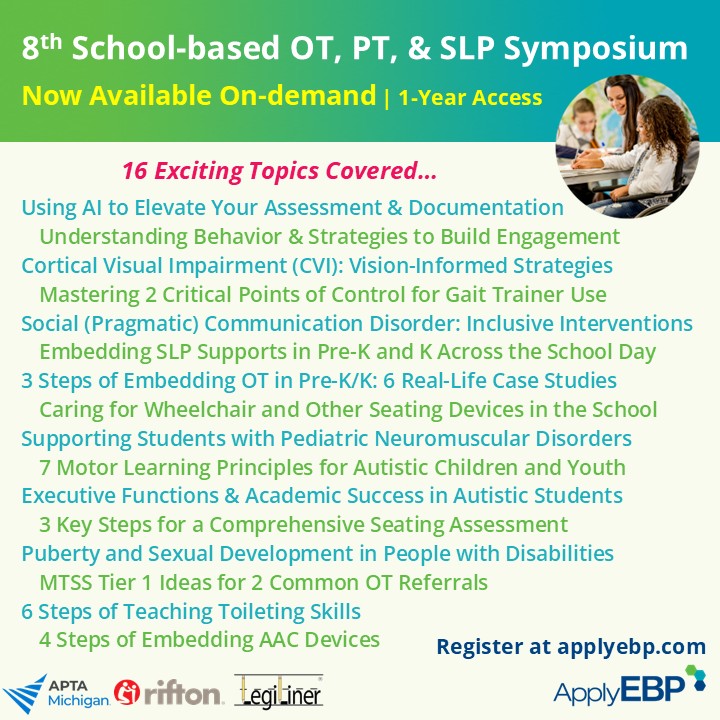
Or these webinars…