
A message to PT and OT practitioners: As healthcare professionals, proper positioning is always top-of-mind to support a student’s comfort, participation, and overall well-being. This article was created as a free resource to empower your school colleagues — teachers, paraeducators, and other school staff who work closely with students each day. It highlights the everyday benefits of good positioning for children, staff, and families. Please feel free to share it with your team to promote collaboration and make positioning a part of everyday practice.
Top 3 Ways Proper Positioning Promotes School Success
For students who cannot easily move or adjust their bodies, how they sit, stand, and lie down can make or break their school day. Positioning isn’t just about comfort — it directly impacts learning, health, and how smoothly daily routines run for teachers, paraeducators, and families. As such, the whole school team should work together to ensure that the student is properly positioned throughout the school day — in sitting, standing, and, even, lying when needed (e.g., nap time).
Here are the top three ways proper positioning promotes school success for students and everyone else in the team:
1. Unlocks Learning and Participation
Proper positioning provides the stable base students need to be active learners and participants. Without it, a child may spend more energy trying to stay upright than on listening, engaging, or completing tasks. When students have good trunk and body support, they can:
-
-
- Use their arms more freely for writing, using communication devices, or manipulating learning tools.
- Sustain attention longer without being distracted by pain or fatigue.
- Interact at eye level with peers — whether in ELA, music, science lab, or physical education — building social connections and confidence.
-
Benefits for Educators: Teachers and paraeducators can shift their energy from constant repositioning, cueing, or redirection to meaningful instruction, communication, and relationship-building. This means more teaching, less physical struggle.
2. Supports Long-term Health
Students with limited mobility face risks such as joint stiffness, spinal curvature, pressure sores, and even breathing or digestive difficulties if they don’t have proper postural support. Positioning isn’t just a comfort strategy — it’s preventive care. With consistent team support, proper positioning helps to:
-
-
- Prevent body distortions: Keeping the body aligned in sitting, standing, or lying down reduces the harmful effects of gravity that cause postural asymmetries.
- Protect internal organs: Good posture prevents internal compression that can compromise breathing, circulation, and digestion.
- Maintain bone and muscle health: Standing devices provide essential weight-bearing, strengthening muscles, bones, and hip joints.
- Reduce pain and discomfort: Poor posture is linked to increased pain. Addressing postural issues can help manage pain and improve comfort.
-
Benefits for Educators: Students can more easily attend to their schooling when they are free from pain, discomfort, and other health complications.
3. Enhances Quality of Life — for Everyone!
Quality of life is about more than health — it’s feeling well, being comfortable, and having the chance to actively participate in daily life. Proper positioning supports this by creating positive outcomes that extend beyond the student.
-
-
- For children: A stable posture means more opportunities to learn and enjoy daily activities.
- For educators and staff: Student participation in lessons and group activities becomes easier and more natural. Transfers, feeding, and toileting can also be safer and less physically demanding.
- For families: Consistent positioning strategies at school and at home reduce stress, help maintain healthy routines, and can even improve sleep.
-
Benefits for Educators: Good positioning can lighten physical workloads, lessen the risk of injury, and create smoother, safer classroom routines. Everyone benefits when students are supported well.
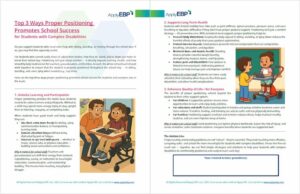
Want a Free 2-Page Handout that you can share with your Teachers & Paraeducators? Click here to join Apply EBP’s Facebook Discussion Group where you can download one from the group “Files” section. Email it to your colleagues, or use it for an in-service in your schools.
The Bottom Line
Proper seating and standing positions are not “extras” — they’re essential. They make teaching more efficient, caregiving safer, and school life more meaningful for students with complex disabilities.
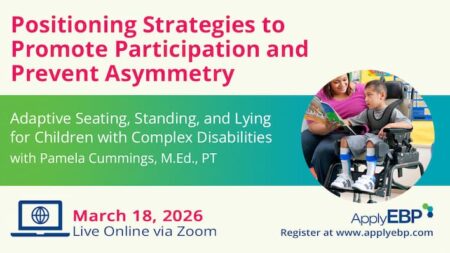
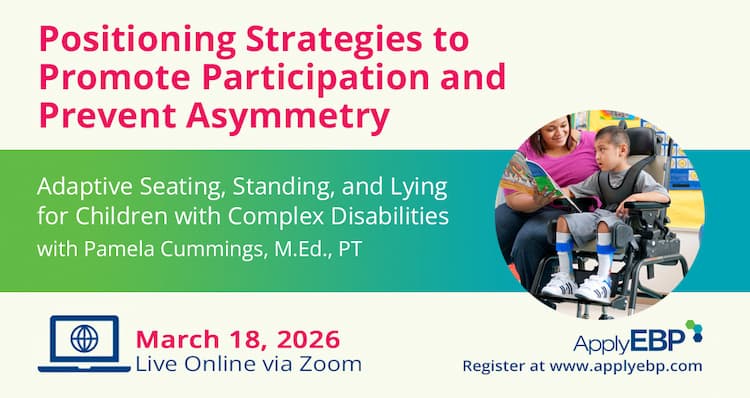
Now they’re onboard! Let’s talk about positioning strategies. Join Pamela Cummings, M. Ed., PT, to discover the power of the 5 Steps of the 24-hour Postural Care Pathway (24PC): Identify, Measure, Select, Implement, and Monitor — and learn how to apply them directly in the school setting…
If you are interested in more evidence-based tools, strategies, and discussions about school practice, join…

Or these webinars…
References
Baylis, M. (2020). 24-Hour postural care and use of sleep systems in cerebral palsy. Paediatrics and Child Health, 30, 296-302. https://doi.org/10.1016/j.paed.2020.05.005
Hulme, J., Gallacher, K., Walsh, J., Niesen, S., & Waldron, D. (1987). Behavioral and postural changes observed with use of adaptive seating by clients with multiple handicaps.. Physical therapy, 67 7, 1060-7. https://doi.org/10.1093/PTJ/67.7.1060
Hulme, J., Shaver, J., Acher, S., Mullette, L., & Eggert, C. (1987). Effects of adaptive seating devices on the eating and drinking of children with multiple handicaps.. The American journal of occupational therapy : official publication of the American Occupational Therapy Association, 41 2, 81-9. https://doi.org/10.5014/AJOT.41.2.81
Inthachom, R., Prasertsukdee, S., Ryan, S., Kaewkungwal, J., & Limpaninlachat, S. (2020). Evaluation of the multidimensional effects of adaptive seating interventions for young children with non-ambulatory cerebral palsy. Disability and Rehabilitation: Assistive Technology, 16, 780 – 788. https://doi.org/10.1080/17483107.2020.1731613
Kenyon, L. K. (2025). Review of Current Technologies in Pediatric Mobility and Standing Devices. Physical Medicine and Rehabilitation Clinics, 36(3), 465-479.
Kenyon, L. K., Harrison, K. L., Huettner, M. K., Johnson, S. B., & Miller, W. C. (2021). Stakeholder perspectives of pediatric powered wheelchair standing devices: a qualitative study. Developmental Medicine & Child Neurology, 63(8), 969-975.
Maximo, T., Foureaux, E., Wang, X., & Fong, K. (2020). Ciranda—An Inclusive Floor Seating Positioning System and Social Enterprise. International Journal of Environmental Research and Public Health, 17. https://doi.org/10.3390/ijerph17217942
McLean, L. J., Paleg, G. S., & Livingstone, R. W. (2023). Supported‐standing interventions for children and young adults with non‐ambulant cerebral palsy: A scoping review. Developmental Medicine & Child Neurology, 65(6), 754-772.
Paleg, G., Williams, S., & Livingstone, R. (2024). Supported Standing and Supported Stepping Devices for Children with Non-Ambulant Cerebral Palsy: An Interdependence and F-Words Focus. International Journal of Environmental Research and Public Health, 21. https://doi.org/10.3390/ijerph21060669
Ryan, S., Campbell, K., Rigby, P., Fishbein-Germon, B., Hubley, D., & Chan, B. (2009). The impact of adaptive seating devices on the lives of young children with cerebral palsy and their families.. Archives of physical medicine and rehabilitation, 90 1, 27-33. https://doi.org/10.1016/j.apmr.2008.07.011
Saavedra, S., & Goodworth, A. (2020). Postural Control in Children and Youth with Cerebral Palsy. Cerebral Palsy. https://doi.org/10.1007/978-3-319-50592-3_161-1
Verschuren, O., Peterson, M. D., Leferink, S., & Darrah, J. (2014). Muscle activation and energy-requirements for varying postures in children and adolescents with cerebral palsy. The Journal of pediatrics, 165(5), 1011-1016.