Q: A child referred to me has CVI, yet their visual behaviors resemble ocular impairment. What distinguishes CVI from OVI?
Although Cerebral Visual Impairment (CVI) and ocular visual impairment (OVI) can look similar in practice, they are not the same condition. They arise from different underlying mechanisms and may require different approaches.
Understanding what sets CVI apart is essential so we are better positioned to interpret behaviors accurately, select appropriate strategies, and provide supports that truly match a child’s needs.
Defining CVI And OVI
Cerebral Visual Impairment (CVI) “encompasses a spectrum of visual impairments caused by an underlying brain abnormality that affects the development of visual processing pathways and is characterized by deficits in visual function and functional vision” (Chang et al., 2024). It is now widely recognized as one of the leading causes of childhood visual impairment in developed countries (Sakki et al., 2018).
In contrast, Ocular Visual Impairment (OVI) — traditionally referred to simply as “visual impairment” — describes vision loss resulting from abnormalities of the eye itself, including retinal disease, optic nerve anomalies, refractive disorders, or ocular motor conditions (Dutton & Bax, 2010).
Historically using the general term “visual impairment” to refer primarily to ocular causes may have contributed to ongoing confusion. In this article, we highlight both the important similarities and the critical differences between these two forms of visual impairment.
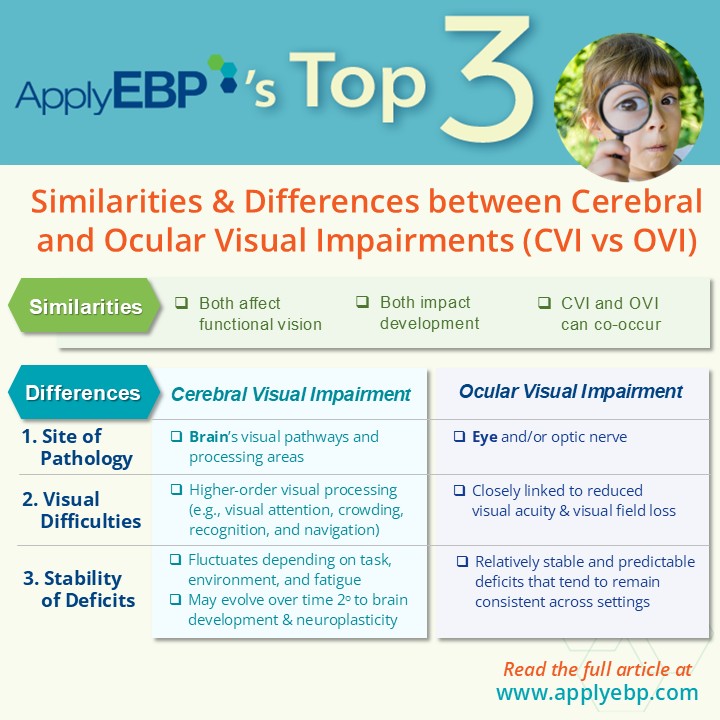
Here are 3 Similarities between CVI and OVI:
1. Both Affect Functional Vision
Across etiologies, visual impairment interferes with a child’s ability to use vision effectively in real-world contexts. In both cases, reduced functional vision may manifest as:
-
-
-
- Difficulty locating objects
- Misreaching
- Reduced visual exploration
- Challenges recognizing faces
-
-
These outward similarities contribute to diagnostic confusion.
2. Both Impacts Development
Literature consistently demonstrates that visual impairment — regardless of origin — affects broader developmental domains, such as:
-
-
-
- Motor coordination
- Reading academic learning, and cognitive development
- Social functioning and participation
- Motor coordination
-
-
Because vision is foundational to development, getting the diagnosis right is not optional — it’s essential.
3. CVI and OVI Can Co-Occur
Yes, to make it even more confusing CVI can co-occur with OVI. Children with complex medical or developmental histories may be at increased risk for both brain-based and eye-based visual impairment.
When both are present, a child may demonstrate:
-
-
-
- Ocular findings such as reduced acuity or visual field differences
- Visual processing difficulties not fully explained by eye structure alone
- Inconsistent or disproportionate functional visual challenges
-
-
This overlap can complicate interpretation and reinforces the importance of comprehensive evaluation when visual concerns persist.
Here are 3 Differences between CVI and OVI:
1. Site of Pathology: Brain versus Eye
The most critical distinction lies in the anatomical origin and nature of the pathology.
In OVI, the primary pathology is in the eye, including the optic nerve, retina, lens, or cornea. In contrast, CVI results from injury to the brain’s visual pathways or processing areas, often in the presence of normal or only mildly abnormal ocular structures. As such, CVI is a neurological visual disorder rather than an ocular condition.
2. Type of Visual Difficulties
Because OVI originates in the eye or optic nerve, deficits are more closely linked to reduced visual acuity and visual field loss. This includes conditions such as myopia, hyperopia, amblyopia, and astigmatism. OVI may also be accompanied by eye pain, irritation, redness, or light sensitivity.
Due to its neurological nature, CVI more frequently affects higher-order visual processing functions, including visual crowding, visual attention, difficulty interpreting complex scenes, object and face recognition, visuospatial navigation, and variable performance with increasing task complexity. Individuals with CVI may demonstrate specific perceptual dysfunctions not explained by acuity loss alone.
Thus, while ocular impairment primarily limits clarity or field of view, CVI disrupts the brain’s ability to interpret visual information efficiently.
3. Stability of Visual Deficits
Because OVI primarily involves damage to the eye structure, it typically produces stable and predictable deficits that tend to remain consistent across settings.
In contrast, variability in visual functioning is a defining feature of CVI.
-
-
-
- Performance may fluctuate depending on environmental factors, task complexity, and fatigue, reflecting changes in higher-order visual processing.
- As a neurological condition, its manifestations may also evolve over time due to brain development, neuroplasticity, and the dynamic nature of neurological injury.
- CVI is frequently accompanied by other neurological comorbidities, such as cerebral palsy, epilepsy, and developmental delays, which can further influence its course and functional impact.
-
-
This inconsistency reflects higher-order perceptual processing impairment rather than primary sensory loss.
Ready to Continue your Evidence-based Practice (EBP) Journey?
CVI and OVI may present with overlapping behaviors, and may even co-occur, but they are not interchangeable diagnoses. Understanding where the visual difficulty originates — and the distinct patterns of visual challenges associated with each — directly influences how we interpret behaviors and design meaningful supports.
If you would like to deepen your understanding of cerebral visual impairment, screening, differential considerations, and how to provide visual-informed intervention strategies, we invite you to join us at our upcoming training designed to translate research into practical application…


References:
Chang, M. Y., Merabet, L. B., Borchert, M., Chandna, A., Heidary, G., Kran, B., … & Wiggs, C. (2024). Special commentary: cerebral/cortical visual impairment working definition: a report from the National Institutes of Health CVI workshop. Ophthalmology, 131(12), 1359-1365.
Dutton, G. N., & Bax, M. (2010). Visual impairment in children due to damage to the brain: A practical approach. Developmental Medicine & Child Neurology, 52(11), 1068–1074. https://doi.org/10.1111/j.1469-8749.2010.03758.x
Martín, M. B., Santos-Lozano, A., Martín-Hernández, J., López-Miguel, A., Maldonado, M., Baladrón, C., … & Merabet, L. B. (2016). Cerebral versus ocular visual impairment: the impact on developmental neuroplasticity. Frontiers in psychology, 7, 1958.
Pehere, N., Chougule, P., & Dutton, G. N. (2018). Cerebral visual impairment in children: Causes and associated ophthalmological problems. Indian journal of ophthalmology, 66(6), 812-815.
Sakki, H. E., Dale, N. J., Sargent, J., Perez-Roche, T., & Bowman, R. (2018). Is there consensus in defining childhood cerebral visual impairment? A systematic review of terminology and definitions. British Journal of Ophthalmology, 102(4), 424-432.