
In this article, we include 3 questions that are commonly asked during our dyslexia presentations.
Dyslexia, also known as specific learning disability (SLD) in reading, is one of the most common learning differences—but also one of the most misunderstood. Among the many myths that persist are misconceptions about what causes dyslexia and how it impacts handwriting.
In this article, we answer three frequently asked questions about dyslexia and handwriting, based on current research and clinical insights. Understanding the real roots of these challenges is the first step in providing effective support to improving the written expression skills of children with dyslexia.
Question #1: Is dyslexia a vision problem?
Dyslexia is a language-based learning difference. It does not stem from a problem with vision.
A common misconception is that dyslexia stems from visual difficulties, such as seeing letters backward or reversing words. While letter reversals can occur in young learners, they are not unique to dyslexia and are often part of typical development through about age 7 (Hebert et al, 2018).
Dyslexia is fundamentally a phonological processing disorder—students struggle with mapping sounds (phonemes) to letters and decoding unfamiliar words (Sanfilippo et al., 2020). Neuroimaging studies consistently show that students with dyslexia underactivate left hemisphere brain regions responsible for phonological and orthographic processing (Handler et al, 2014; Lueder et al., 2009).
As such, effective intervention focuses on explicit, systematic instruction in phonemic awareness, phonics, and language structure. And because it is not a visual processing problem, implementation of behavioral vision therapy, eye muscle exercises or colored filters are not recommended for dyslexia by the American Academy of Pediatrics, the American Academy of Ophthalmology, the American Association for Pediatric Ophthalmology and Strabismus, and the American Association of Certified Orthoptists (Handler et al, 2014).
Question #2: Are handwriting difficulties in dyslexia primarily caused by poor motor skills?
Handwriting difficulties in individuals with dyslexia are more closely related to their language-based learning difficulties than to motor skill deficits.
As a language-based learning disability, dyslexia disrupts phonological processing, working memory, and rapid retrieval of verbal information. These same cognitive processes are crucial for writing. When they’re impaired, they can make handwriting more difficult—not because the hands can’t form letters, but because the brain struggles to keep up with the demands of spelling and language processing.
For example, studies have found that handwriting issues in dyslexia are more closely linked to spelling difficulties than motor problems. Hesitation and uncertainty in spelling can interrupt the rhythm and flow of writing, making handwriting slower and less legible (Berninger et al., 2008; Pagliarini et al., 2015).
In addition, children with dyslexia often have difficulty with executive functions—many of which are required for writing—such as planning, organizing, self-monitoring, and working memory (Hebert et al., 2018).
This is not to suggest that motor skill deficits are never present in children with dyslexia. In fact, several researchers have reported that dyslexia may co-occur with developmental coordination disorder (DCD) (Nemmi et al., 2023) or with specific learning disabilities in written expression (previously referred to as dysgraphia — more on this in a separate article). Consequently, effective handwriting assessments should address not only motor skills, but also the language and executive function skills discussed above.
Want to know whether a child may have DCD? Read the SeekFreaks article “Just Clumsy? Or Is It DCD?… and Why It Matters” by Erin Iverson, PT, DPT, PCS.
Question #3: Will handwriting remediation solve writing difficulties of children with dyslexia?
No—handwriting remediation alone isn’t enough. Writing difficulties in dyslexia require a team approach that also addresses language and executive function skills.
Occupational therapy (OT) practitioners are often tasked to help children with dyslexia improve their writing. While remediating the motor aspects of handwriting with OT can improve legibility and fluency, it is not a sufficient solution for children with dyslexia. (As discussed above, motor skill deficits are often not the primary cause of their handwriting difficulties.)
Since their handwriting challenges are rooted in broader language and executive function difficulties, effective intervention requires collaboration among different school team members – the general and special educators, speech and language pathologists, and/or OT practitioners – and not one discipline alone. A well-rounded plan for improving written expression should include:
-
-
- Language interventions
- Systematic, evidence-based reading instruction addressing these five key components: phonemic awareness, phonics, fluency, vocabulary, and comprehension
- Spelling instruction
- Explicit teaching of text structure
- Executive function strategies to address working memory, planning, organization, self-monitoring, and self-regulation
- Explicit handwriting instruction (click here for concrete evidence-based ideas)
- Assistive technology and low-tech supports
- Accommodations
- Language interventions
-
Each of these components addresses a different layer of the writing challenges children with dyslexia face.
The Next Step in Your Team’s Dyslexia Learning Journey
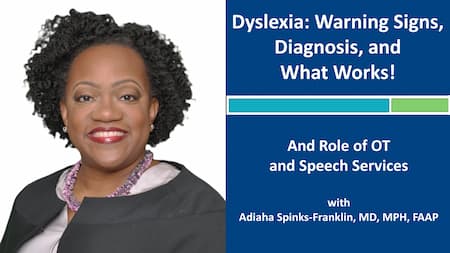
We hope this article got your team started on reflecting on providing a comprehensive evidence-based approach to support students with dyslexia. To gain deeper insight into the early red flags of dyslexia—and to dive deeper into the evidence-based strategies outlined above—take Dr. Adiaha Spinks-Franklin’s engaging on-demand webinar, “Dyslexia: Warning Signs, Diagnosis, and What Works! And Role of OT and Speech Services.” It’s packed with expert guidance for educators, therapists, and families alike, from a board-certified Developmental-Behavioral Pediatrician.
If you would like to learn more about other school-based topics…




References:
-
-
- Berninger, V. W., Nielsen, K. H., Abbott, R. D., Wijsman, E., & Raskind, W. (2008). Writing problems in developmental dyslexia: Under-recognized and under-treated. Journal of School Psychology, 46, 1–21.
- Berninger, V. W., Richards, T. L., & Abbott, R. D. (2015). Differential diagnosis of dysgraphia, dyslexia, and OWL LD: Behavioral and neuroimaging evidence. Reading and Writing, 28, 1119–1153.
- Fischer, F. W., Liberman, I. Y., & Shankweiler, D. (1978). Reading reversals and developmental dyslexia: A further study. Cortex, 14, 496–510.
- Graham, S., & Harris, K. R. (2003). Students with learning disabilities and the process of writing: A meta-analysis of SRSD studies. New York, NY: Guilford.
- Handler, S. M., Fierson, W. M., & Section on Ophthalmology and Council on Children with Disabilities, American Academy of Ophthalmology, American Association for Pediatric Ophthalmology and Strabismus, and American Association of Certified Orthoptists. (2011; Reaffirmed 2014). Learning disabilities, dyslexia, and vision. Pediatrics, 127(3), e818-e856.
- Hebert, M., Kearns, D. M., Hayes, J. R., Bazis, P., & Cooper, S. (2018). Why children with dyslexia struggle with writing and how to help them. Language, Speech, and Hearing Services in Schools, 49, 843–863.
- Moats, L. C. (1983). A comparison of the spelling errors of older dyslexic and second-grade normal children. Annals of Dyslexia, 33, 121–140.
- Nemmi, F., Cignetti, F., Vaugoyeau, M., Assaiante, C., Chaix, Y., & Péran, P. (2023). Developmental dyslexia, developmental coordination disorder and comorbidity discrimination using multimodal structural and functional neuroimaging. Cortex, 160, 43-54.
- Pagliarini, E., Guasti, M. T., Toneatto, C., Granocchio, E., Riva, F., Sarti, D., & Stucchi, N. (2015). Dyslexic children fail to comply with the rhythmic constraints of handwriting. Human Movement Science, 42, 161–182.
- Santangelo, T., & Graham, S. (2016). A comprehensive meta-analysis of handwriting instruction. Educational Psychology Review, 28, 225–265.
- Treiman, R., Gordon, J., Boada, R., Peterson, R. L., & Pennington, B. F. (2014). Statistical learning, letter reversals, and reading. Scientific Studies of Reading, 18, 383–394.
- Vellutino, F. R., Pruzek, R. M., Steger, J. A., & Meshoulam, U. (1973). Immediate visual recall in poor and normal readers as a function of orthographic–linguistic similarity. Cortex, 9, 370–386.
-